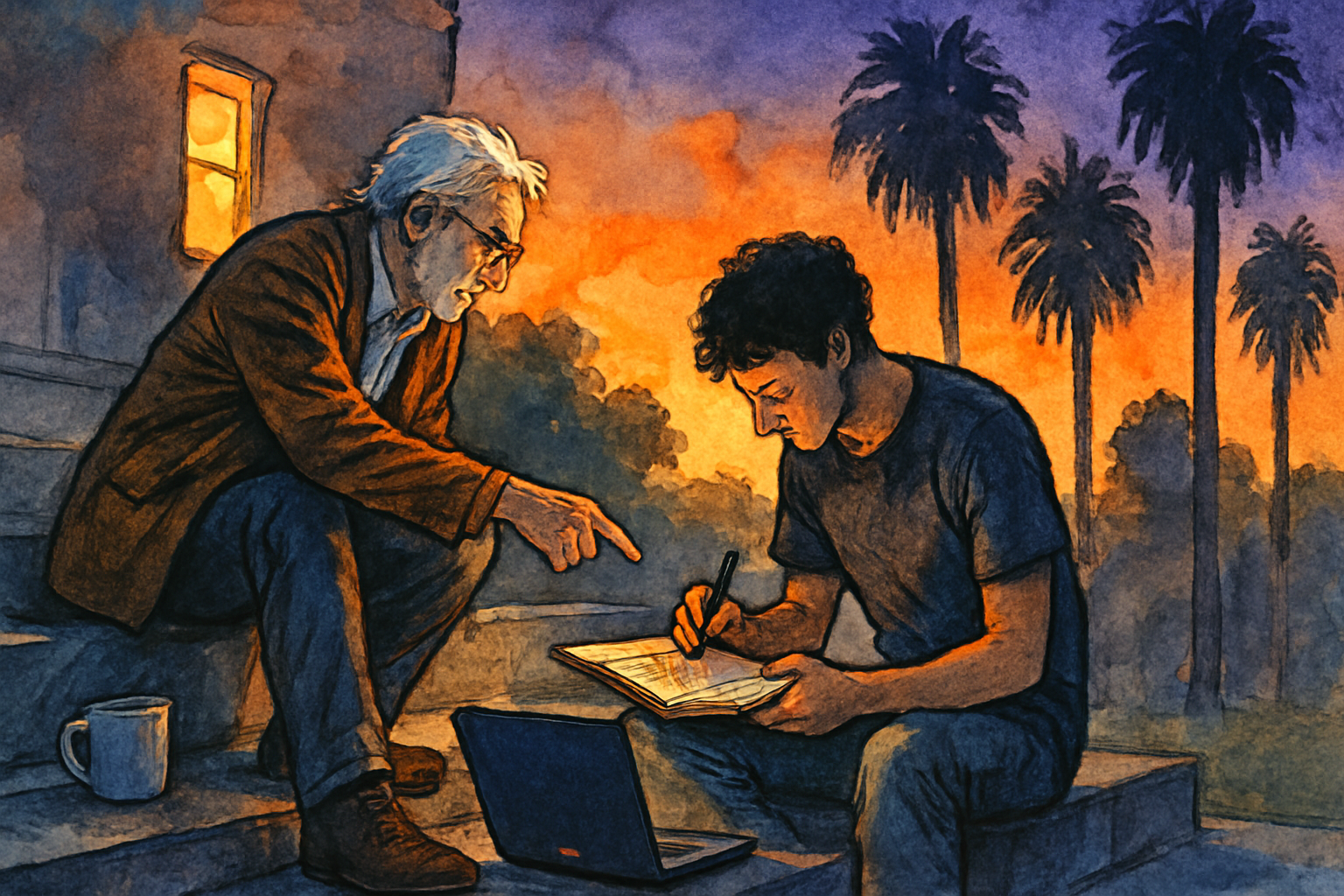
I have been teaching graphic design for twenty-five years, and somewhere along the way I stopped being surprised by my students. Not because they became predictable. Because I learned that the only safe assumption about a student is that you have no idea what they are carrying when they walk through the door.
I had a student a few years back, I’ll call her A, who was eight months pregnant when the semester started. Her husband, she told me later, had given her very clear odds on whether she would finish. He thought she would drop, take care of the baby, and let the degree fall away the way a lot of things fall away in that season of life. He was not cruel about it. He just knew the math: a new baby, a new semester, a program that demands real hours in front of the screen. The math did not favor her. She had the baby on a Friday via C-section. She was back in class on Monday, sitting in the front row, grandmother watching the newborn. She did not miss a single deadline.
I want to be careful about what I say next because I have seen people turn a story like this into a lesson about hustle, or grit, or grinding through pain. That is not what I saw. What I saw was someone who had decided that her creative work was part of who she was, not something she was pursuing in the time left over from the rest of her life. The baby was real. The semester was real. Both of them were hers. She was not choosing between them. She was choosing to hold both.
By the end of that year, she had built a client roster, won a student award, and was doing professional work that I would have been proud of at any level. She eventually left her husband. That is not the point of this story, but it happened, and I think it mattered: she found out during that semester what she was actually made of, and some things that had seemed fixed stopped looking fixed. She still reaches out a few times a year. She is doing well.
I have a thousand versions of this story. The veteran who came to me with fifteen years of logistics and tactical decision-making behind him and could not figure out what any of that had to do with a career in design. It took half a semester for him to understand that he already knew how to manage complex information systems, allocate resources under constraint, and adapt when the original plan dissolved. He thought he was starting over. He was actually translating. By graduation he had one of the most precise design minds I have ever worked with, because precision was already in him from years of practice. He just had not seen it operating in a visual context before.
Or the student who came in with a Goosebumps story she had written at eleven, folded and refolded until the creases were nearly transparent, because she wanted me to know she had always been a creative person even though nothing in her adult life had made room for it. She was thirty-four. She pulled it out of her bag on the first day and put it on the desk between us like a credential. I understood exactly what she was doing. She was showing me who she was before the world told her who she had to be instead. That story, worn at the corners, was evidence. We talked about it for twenty minutes and she had not even opened the software yet.
Here is what twenty-five years of watching this has taught me: the students who are most likely to become real designers are not the ones who arrive with the most polish. They are the ones who arrive with the most at stake. The ones who have a reason that is bigger than grades. The single mother sitting in the front row with a C-section scar that is still healing. The veteran who drove forty-five minutes each way twice a week because he had promised himself he would try something new. The thirty-four-year-old with the Goosebumps story. They are not the easiest students to teach. They are the most alive ones.
I teach because of them, honestly. Not the students who arrive ready and motivated and sail through. Those students are a pleasure and I am glad they are there. But the ones who should not statistically make it, who have the math against them, who are working full-time and raising children and dealing with the full weight of an adult life and still showing up and still turning things in and still asking me what they could have done differently on the piece that did not land the way they wanted. Those students remind me every semester that learning is not primarily about ability. It is about willingness to stay in the room. And most people have more of that than they have ever been asked to use.
If you have a story like one of these, a version of yourself that was told the math did not work out in your favor, I want you to know that I have seen what happens when people ignore that math. More times than I can count. The math is usually wrong. Not because ability is unlimited or effort always wins. Because what other people see when they look at you is almost always incomplete. They see the surface data. They do not see what you know about yourself when nobody is watching, what you are willing to do when it matters, what you were before the world started keeping score. The student who came back on Monday knew something her husband did not. You probably know some things too that the people counting your odds have missed.
For Further Reading
Explore these resources for deeper context on the ideas in this post.
- UX Mindsets: Fixed Versus Growth (NN/g) — Habit formation and growth in design
- What are Creative Blocks? (IxDF) — Momentum loss and creative paralysis