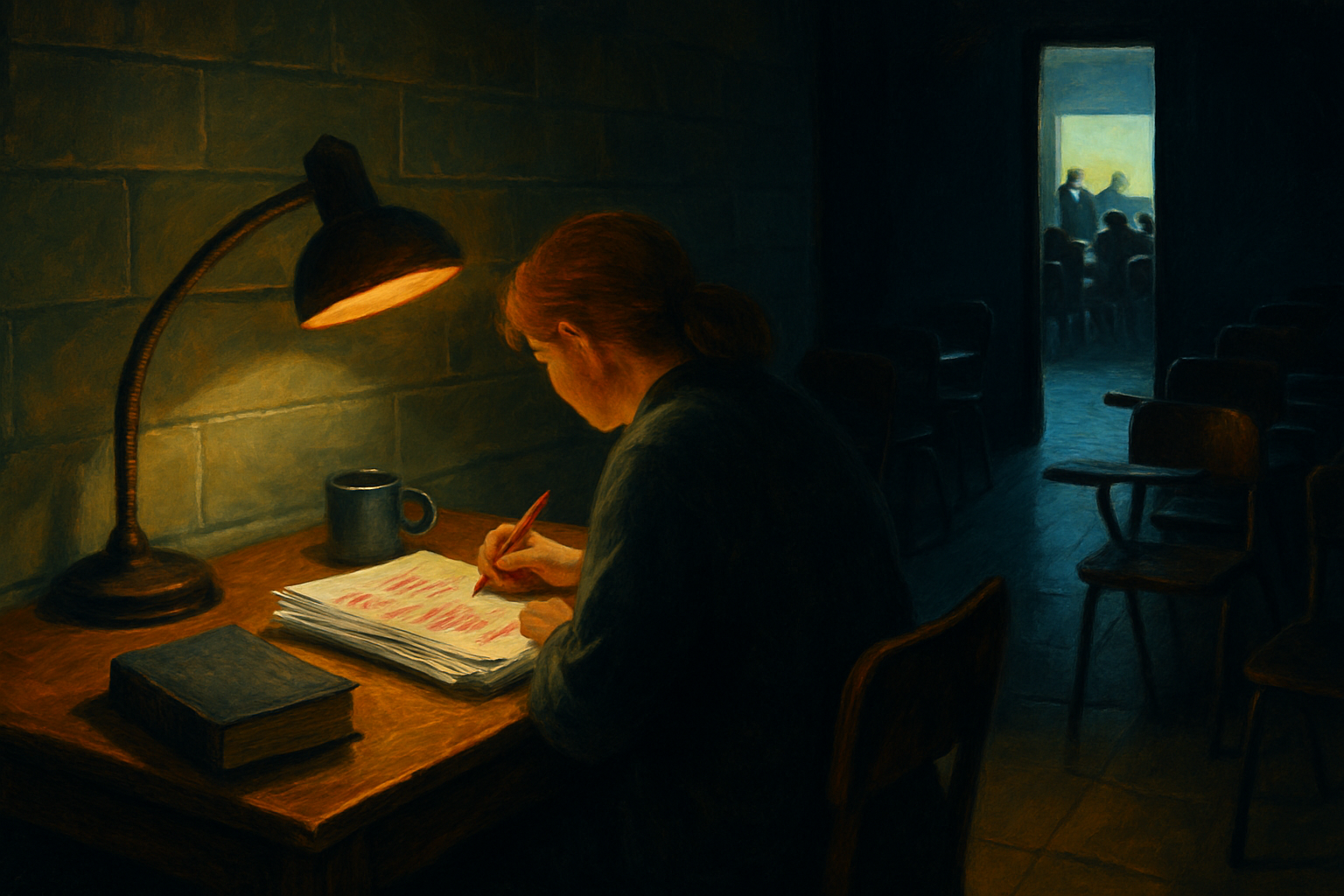
Structure Shapes Creativity.
Everyone talks about creative freedom like it’s the absence of rules, like the best artists are the ones who wake up one morning and decide there are no boundaries, and that’s when the real magic happens. I spent years believing something close to that before I had to actually organize 650 creativity exercises into a usable system, and that project taught me something that completely inverted what I thought I knew about how constraints work. The structure isn’t what limits the creativity; the structure is what makes the creativity possible.
I didn’t set out to create 650 exercises. I taught for years accumulating prompts and activities and sketches that worked in the classroom, things that would push students to think differently or make differently, and over time I realized I had this body of knowledge that I needed to make sense of. It wasn’t just a pile of good ideas; it was material that needed to be organized in a way that would actually be useful for someone who wasn’t me. So I started sorting. I created categories. I looked at what was working and asked why, and I built sequence into the organization so that an earlier exercise would prepare someone for what came next, like the exercises themselves had to build on each other. And here’s where the structure started doing its actual work.
You know what makes you stop thinking about whether something is creative or not? Constraints. Real ones. I gathered a panel of people, and I gave them my research, my organization, and I said one thing: debate. Come up with exercises. And you can’t stop until you’ve hit a certain number per category. You have to convince everyone in the room that each exercise is worthwhile. You have to use research and evidence, not just intuition or nostalgia. You can’t say, “I like this one,” and move on. You have to defend it against scrutiny, and if the panel isn’t convinced, you come back with better justification or you drop it. That constraint, that absolute number you had to hit, that requirement to convince others, that was what created the real pressure on the thinking.
Here’s what I noticed happening during those debates. People weren’t becoming more conservative or repetitive. They were becoming more inventive, more specific, more precise. When you have one option for how to teach a concept, you don’t actually know if it’s right; you just use it because it’s what you have. When you have two options, you can say one is better. But when you have ten options and you can only keep five, now you’re making real evaluations. You have to understand not just what each exercise does, but how it differs from the others and whether that difference matters. You have to get specific about what you’re actually trying to accomplish, and that specificity is creative.
The structure forced us to be clearer about what we were doing and why, which means the exercises themselves had to be better. They couldn’t coast on charm or tradition; they had to earn their place in the system by proving they did something the other exercises didn’t do. We had to organize them sequentially so that someone could move through them with preparation, progression, intention, and that sequential requirement meant every exercise had to position itself relative to what came before and what came after. The structure wasn’t constraining the creativity; it was demanding that the creativity be coherent.
This is so counterintuitive that I still have to think through it when I explain it, and I’ve been living it for years now. We’re trained to believe that the absence of constraints is freedom, but it’s actually paralysis. If I said to you, “Make something creative with no rules, no structure, no boundaries, you can do anything,” what would you do? You’d probably freeze. You’d have so much possibility that you’d have no path forward, and that’s not freedom; that’s vertigo. But if I said, “Make something that takes exactly five minutes to make, uses only paper and pencil, and teaches someone something about the proportion of the human head,” now you have constraints, and within those constraints you have real freedom. You know what you’re making and why, and that clarity lets you be genuinely inventive.
I see this all the time in teaching, and I probably didn’t have language for it when it was happening. I’d give a structured assignment with clear constraints and the work would come alive. Students would produce something unexpected and personal within a framework that had been deliberately built. Then I’d give them a completely open prompt and I’d get, honestly, some really hollow work. Students would make safe choices. They’d make what they thought art school wanted them to make instead of making what they actually thought or felt. The constraints had been what was protecting them, giving them permission to be brave because the boundaries were clear.
This is what the sequence of exercises became, when I finally got the organization right. Not a list of activities. A system of constraints that, if you moved through them, would build your capability progressively and position you to understand the next thing you needed to understand. The constraint of sequence forced us to make each exercise better than it would have been if we were just saying, “Here’s a good activity; here’s another good activity.” We had to make them cohere. We had to make them matter relative to each other.
I’m building My Design Helper with this same understanding now. The constraints aren’t limitations; they’re what’s going to make the system useful. We’re not trying to do everything; we’re trying to do something specific, and that specificity is going to force us to make better decisions about what belongs in the system and what doesn’t. Every feature has to earn its place by proving it does something meaningful for someone trying to improve their creative practice. Every exercise, every prompt, every piece of guidance has to position itself relative to everything else in the system and justify itself not because it’s clever but because it serves a coherent purpose.
So I’m curious about what constraints you’re holding in your own work. Are you treating them as the enemy, as the things that are keeping you from being fully creative? Because if you are, I’d ask you to flip that question. What if the constraints are actually what’s going to make your work better? What if having to work within a budget, a timeline, a particular medium, a specific goal, is not the thing that’s limiting your creativity but the thing that’s actually enabling it?
Further Reading
- Machine Learning Has Already Transformed Design (AIGA) — Platform dependency risks
- Design Systems vs. Style Guides (NN/g) — Building your own vs. depending on others’ systems