You Can’t Teach Making by Explaining It.
I’ve been teaching design for 25 years, and I can tell you with absolute certainty that you can teach someone every single tool in Adobe and they will produce work that is technically flawless and completely hollow. The tools don’t matter nearly as much as people think they do, and learning about design principles, color theory, typography, all of that foundational knowledge, it’s necessary but it’s not sufficient. You can explain grid systems and hierarchy and proportion until your voice gives out, and the student will take notes and understand everything you’re saying and then sit down to make something and produce work that’s technically correct and utterly without presence, and the question they’ll have is: why doesn’t this feel alive the way the work feels alive that the good students are making? The answer is that explanation was never going to teach them how to make.
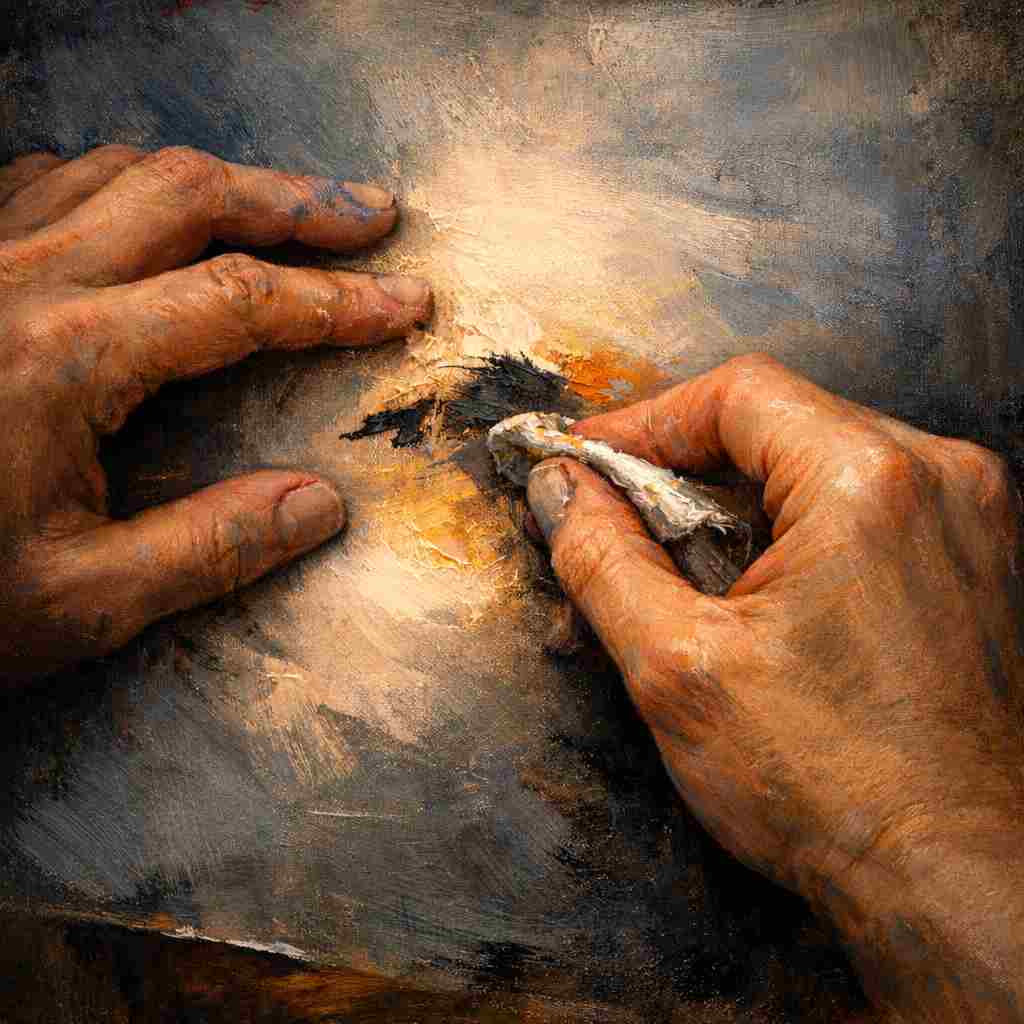
Making teaches making. The hand has to move. The student has to fail and then try again, has to discover through practice that one choice lands better than another, has to feel the difference in their body before they can understand it in their mind. I watched this for years without fully articulating what I was seeing, but it became undeniable when Kerri and I shared a classroom for fifteen years, five hours a day, five days a week, with advanced and beginner students mixed intentionally. The advanced students were there reinforcing their knowledge by teaching it to the beginners, and the beginners were getting a preview of what they were going to be capable of. But the learning didn’t happen in the critique circle where I explained principles. It happened in the studio, in the making, in the moment when a beginner watched an advanced student make a decision in real time and then understood something they never could have understood from lecture.
Here’s what I mean by technically correct work being hollow. The student has learned the tools. They’ve watched tutorials. They understand the principles. They sit down and they make something that follows every rule they’ve been taught. The proportions are right. The color relationships are sophisticated. The typography is appropriate. There’s nothing wrong with it. And there’s nothing in it. It’s like looking at work that’s been made to pass a test instead of work that’s been made because someone had something to say.
The student who learns every tool perfectly but has nothing to say with those tools, that’s a student who’s spent their education learning about design instead of learning how to design. They can pass the exam. They can talk the talk. But when you put them in front of a blank canvas and say, “Make something true about yourself,” they freeze. Because no one taught them how to access what they actually think and feel and transform that into visual language. That’s not something you can explain. That requires making, and failing, and making again, and slowly discovering what only they have to offer.
I started teaching when I was 39 and a half years old, and I had spent seventeen years before that in my own creative practice, making things, teaching myself through the work. So by the time I got into a classroom, I understood in my body what it meant to make, and I understood the difference between technical skill and having something to say. I tried for years to teach the difference by explaining it better, by finding the right words, by showing examples and talking about what made them work. And I would see the light go on sometimes, and the student would nod and they’d understand. And then they’d go back to their computer and they’d make the same kind of hollow work they were making before, and I realized the understanding I had created in their mind with my explanation was not the same thing as the understanding that happens when their hands are moving.
So the classroom changed. We didn’t stop talking, but the talking became less important than the making. We spent more time on exercises where students had constraints and had to make something, and then we’d look at it together, and I’d ask questions. Why did you make that choice? What were you trying to say? Can you see what happens if you push that further? The student would go back and make again, and through the repetition, through the failure and the adjustment and the discovery, they would start to develop their own voice. That voice didn’t come from understanding the principles. It came from the friction between their intention and the material, from the thousands of small decisions they made while their hands were moving.
There’s a moment that happens sometimes in a classroom, and it’s the only moment I’ve found that matters in teaching, when a student’s personality breaks through the technical competence and something alive starts to show up in their work. You can see it. There’s a different energy in what they’re making. They’ve stopped trying to make it right and they’ve started trying to make it true, and that shift doesn’t happen because they finally understood what you were teaching. It happens because they’ve made enough things, failed enough times, adjusted enough iterations, that they’ve discovered something that only they can offer. That’s a student who’s learning to design. The ones who are learning about design are still in the classroom, taking notes, nodding at the lecture, and going back to their computer to make work that’s correct and cold.
This is hard to say plainly because it sounds like I’m dismissing everything that’s intellectual or teachable, and that’s not it at all. You need the knowledge. You need to understand principles and tools and process and all of it. But the knowledge serves the making; the making doesn’t serve the knowledge. The student who understands everything but hasn’t made anything is further behind than the student who’s made a hundred things and understands almost nothing, because the hundred things are going to teach that student more than any explanation ever could.
I spent years trying to be a better explainer, a better teacher in the sense of transmitting knowledge, and the real shift came when I stopped trying to teach design and started creating conditions for students to learn how to design. I gave them constraints. I gave them time to make. I gave them feedback that pushed them back into the making instead of into more thinking. And the ones who got it, the ones who developed real capability, were the ones who showed up to the making and stayed with it long enough to feel the difference between work that’s technically correct and work that’s alive.
Here’s what I wonder about for you. What have you learned by doing that you never could have learned by reading or listening or having someone explain it to you? Because that’s the thing. That’s where the learning lives. And if you’re trying to get better at something, the only path I know is to make, and to make again, and to pay attention to what your hands are discovering that your mind hasn’t caught up with yet.
Further Reading
- The Seven Principles of Universal Design (IxDF) — Subtraction and universal design
- Before Design Thinking (PRINT Magazine) — Reductive approaches to design education