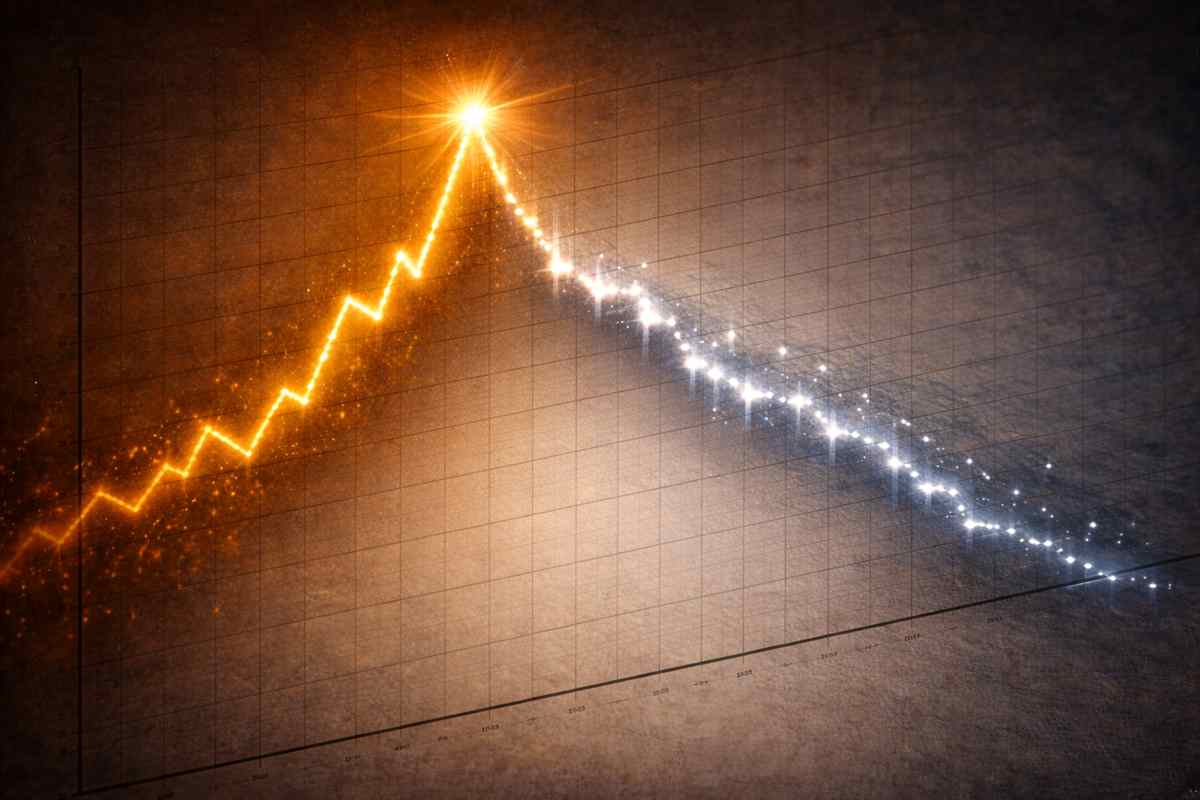
You remember the last time gas jumped. A conflict somewhere, or a refinery shutdown, or something disrupts the supply chain, and suddenly the pump prices spike. Not gradually, not over weeks. Within hours, sometimes within a day, the price per gallon jumps thirty cents or forty cents, and you feel it every time you fill up. Your commute got more expensive overnight. Your budget got tighter. This is a pattern you’ve probably noticed, and I want to explain what you’re actually looking at, because once you understand this particular mechanism, you start to see it operating in almost every market in America.
Here’s what’s happening. The oil that’s in those tanks at the gas station right now was purchased days ago, before the price spike. The refinery that made it bought crude at the old price. The distributor moved it into the tank at the old price. By the time you pull up to the pump, the commodity price has jumped, but the gasoline in that particular tank was produced and purchased at a significantly lower cost. So you’re paying the new, spiked price for gasoline that cost a fraction of that to produce. The margin between the cost of the product and the selling price just expanded dramatically. That’s not a supply chain delay. That’s a margin window, and it’s entirely intentional.
Now the conflict resolves, or the refinery comes back online, or the supply shock passes. Crude oil prices start falling. You’d think that would flow straight back to the pump, right? Prices spike up when crude spikes, prices fall when crude falls. But that’s not what happens. Pump prices fall, yes, but at a fraction of the speed they rose. A price spike that happened in a day gets reflected slowly over weeks. Why? Because once again, the product in the tank was purchased at the old price, but now they’re selling it at the new, higher retail price while they’re buying replacement stock at falling wholesale prices. The margin window is still open, and they’re still capturing it.
I’ve been watching this exact pattern for thirty years, and it is not subtle. I have a spreadsheet full of dates and numbers that documents it happening over and over. Crude oil prices fall twenty percent in a month, and retail pump prices fall five percent in the same month. The margin expands to accommodate the opportunity, and it stays expanded until it can’t be held any longer. But that window, that extraction window, it’s open every time this happens, and the numbers that come out on the other side tell a very specific story.
The pattern isn’t accidental. It’s not a supply chain lag that happens to work out in favor of the retailer. It’s operating exactly as if someone understood, in advance, that this is how it works. The same thing plays out with groceries. Supply costs go up because shipping gets expensive or labor costs rise or weather affects a harvest. Retail prices spike to match, or sometimes exceed, the cost increase. Then the supply cost comes back down. Shipping normalizes, labor markets shift, the harvest comes in better next time. But retail prices don’t fall with them. They hold. Maybe they inch down, but not at the speed they climbed. And during that window, corporate earnings reports show remarkable numbers. Revenue looks great. Margins are fantastic. Profit margins expand exactly when you’d expect them to compress.
I’m not writing this as a partisan statement. I’m following the money and describing what I’ve observed. This isn’t about whether oil companies are good or bad or whether grocery chains are villains. This is about understanding how markets actually function versus how they’re supposed to function according to economic theory. In theory, if production costs fall, selling prices should fall with them, because that’s how competition works. Dozens of competing sellers should bid prices down because each one wants to gain share by undercutting the others. But that’s not what’s happening. The price of producing something and the price of selling it are supposed to move together. When they decouple, and they decouple only in one direction, that’s not economics. That’s extraction.
We’re being billed out of billions of dollars that are going directly into corporate profits, and it happens so gradually, across so many different transactions, that you never see it as a single number. You see your grocery bill go up. You see your gas fill-up cost more. You see your electricity bill increase. You blame inflation, or supply chains, or the cost of doing business in a complicated world. You don’t add them all up and recognize that you’re transferring wealth, systematically and consistently, to corporations that understand how the timing works. The moment that was supposed to be temporary becomes permanent. The margin window that was supposed to compress stays open, and next quarter’s earnings are better than the last quarter’s because the cost structure didn’t fall as fast as the selling price fell.
What you need to understand is this: the speed of price movement tells you something crucial about how power flows in that market. When prices go up fast and come down slow, that’s a sign that someone in the chain has learned how to hold the gap open. They’ve learned that they can afford to, because they have enough market concentration that competitors won’t undercut them into oblivion. Or they’ve learned that customers are inattentive enough that slow price decreases go unnoticed. Or both. But the asymmetry of speed is never an accident. It’s a feature of the system. And once you’ve seen it, you start seeing it everywhere: in medical bills, in airline ticket pricing, in insurance premiums, in software subscriptions that promise to raise prices when costs rise and somehow always forget to lower them when costs fall.
For Further Reading
Explore these resources for deeper context on the ideas in this post.
- Machine Learning Has Already Transformed Design (AIGA) — Platform dependency and ethical AI use
- AI Design Tools Are Marginally Better (NN/g) — Critical evaluation of AI tool reliability