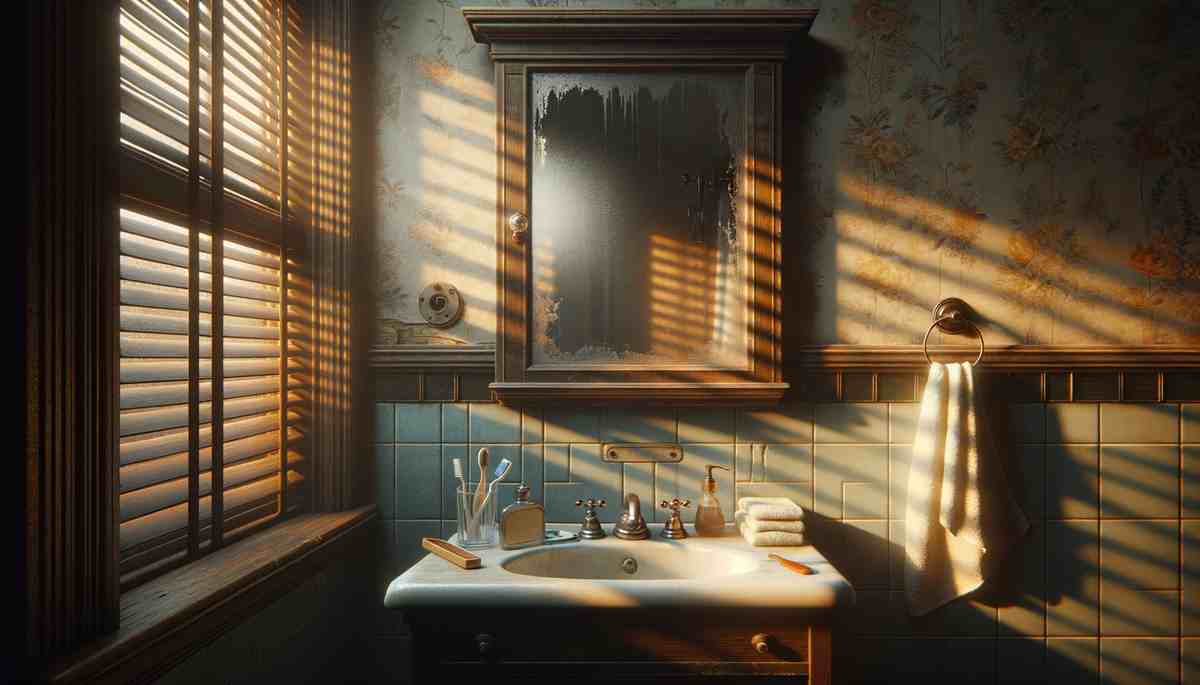
Nine or ten years ago, I was standing at the bathroom sink, I don’t remember the exact morning, and I looked up at the mirror the way you do a hundred times a day without actually looking, and I actually looked. I said, out loud or just somewhere behind my teeth, you know what, I like you. I like who you turned into. I like what you stand for. I like what you believe in. And I realized, standing there brushing my teeth or reaching for a razor or whatever I was doing, that I had just done something I had never done before in my entire life. Not at twenty. Not at thirty. Not at thirty-eight when everything was still smoldering. I had just met myself in the mirror and I had liked the person who was looking back.
I want you to understand that most of my adult life before that moment had been spent quite sure the person in the mirror was a problem to be solved. Not in a dramatic way. Not in a way anybody looking at me from the outside could have told you. I was functional, I was working, I was doing things that looked like a life. But the person inside that reflection was usually on a list of things I was going to fix later. When I got more successful. When I got the next thing. When I finally earned the right to exhale. And so I would look past him on my way to whatever I was off to prove next, and I wouldn’t stop to ask the man whether he was okay with what was being asked of him.
What changed is not that I finally fixed him. That’s the part most people assume. They assume there’s a makeover story in here somewhere, that I went off and did the work, and one morning I came back out of it glowing with new self-acceptance. That’s not how it happened. What actually happened is closer to the opposite. I stopped assuming the version of me that would be worth liking was ahead of me somewhere, and I noticed, kind of by accident, that the version I already was, the version that had been through the collapse at thirty-eight and moved into the back of my parents’ house and spent a decade picking himself up one day at a time, was a version I had started to respect. I hadn’t set out to. I had just lived long enough, and paid enough attention, that the respect snuck in the back door when I wasn’t guarding against it.
And that was when I started getting uncomfortable with the way we define success. You know the version I mean. The version where success is the car, the title, the house, the influence, the number in the account, the number of people who’ve heard your name. I spent a long time chasing some flavor of that. I’ve had more of it and I’ve had less of it, and I’ll tell you, the amount of it I had never correlated at all with whether I could look in the mirror and like the guy. The amount of money in the account never moved that needle. The job title never moved that needle. The size of the car never moved that needle. None of the things we are told will earn us that moment at the sink actually earn it.
What earns it, as far as I can tell, is the journey. All of it. The triumphs are part of it, obviously, but I don’t think the triumphs are the part that does the most work. I think the defeats are doing more of the work. The moments of despair are doing a lot of the work. The times you made the wrong call, or the coward’s call, or the call you’d quietly take back if you could, those are doing work too, and they’re doing it in a way the wins can’t. The wins give you confidence. The losses give you a self. And when I stood at the sink that morning and nodded at the guy in the mirror, what I was nodding at was not the wins. I was nodding at the whole long composite. The kid at Hargrave. The twenty-something who didn’t know what he was doing but kept going. The thirty-eight-year-old with nothing. The forty-something learning to teach with marker smeared across his face. All of it. I liked him because of what he’d survived and what he’d done next.
I’m going to be careful here because I don’t want to make this sound like some finished, tidy conclusion about self-acceptance. It isn’t finished, and it isn’t tidy, and most days I’m not thinking about it at all. It comes back to me in quiet moments, usually right after somebody has said something that makes me proud of the work, or right before I’m about to walk into a room where I’ll need the man in the mirror to show up with me. And when it comes back, it comes back with a kind of gratitude that I didn’t invent. I didn’t earn it by grinding a certain number of hours. I didn’t unlock it with a credential. It showed up because enough decisions and enough years stacked up that the person on my side of the mirror and the person on the other side of the mirror finally recognized each other.
Here’s the part I want to say directly to whoever’s reading. If you are waiting to like yourself on the condition that you become more successful, or more lean, or more calm, or more whatever the current list is, I would invite you to consider the possibility that the condition is backwards. The man I liked at the sink that morning wasn’t a more successful version of me. He was just a version who had finally gotten tired enough of waiting for permission to be on his own side. And the thing that surprised me about that moment, which I still haven’t quite gotten over, is how small it was. It didn’t come with trumpets. It came with a toothbrush and a rinse and a quiet sentence in my head that said, well, I like you.
You might be closer to that moment than you think. And you might not be, and that’s fine too, because nothing in this is meant as a prescription. The only thing I’d ask is that the next time you pass a mirror, you slow down enough to look at whoever is in there the way you’d look at a friend you were meeting for coffee. Not to assess them. Not to grade them. Just to see them. Some morning, maybe not this one, maybe one a long way out, you’ll find yourself saying what I said. And when you do, I think you’ll notice what I noticed, which is that you’ve been waiting for that sentence your whole life, and the conditions for it were quieter than you ever thought they were going to be.