
I had been giving the same assignment for years. It asked students to analyze a design choice, explain the thinking behind it, and make the case for why it worked. On paper, it was a good assignment. It asked for reasoning. It asked for judgment. It asked students to explain themselves.
And then AI tools became widely available, and something changed. Not the assignment. Not the students. Something subtler.
The work started to look right without being right.
I graded papers that had all the components. They addressed the prompt. They used the vocabulary of the discipline. They made arguments. But reading them, I kept having the same feeling I get when someone gives me directions by reading the street signs out loud. Technically accurate, and completely useless. Something was going on with these papers, and for a while I could not say exactly what it was.
Here is the misconception I brought to this situation. I assumed the problem was with the students. Some of them were taking shortcuts. Some of them were leaning on AI to do their thinking. The solution, I figured, was to catch the shortcuts. Make the assignment more specific. Add more steps. Require more documentation. Make it harder to fake.
That is the wrong diagnosis.
It is not a student problem. It is a design problem.
I found this out the hard way. One evening during a faculty development session I was running, I tried something. I opened an AI tool, pasted my own assignment into the chat, and asked it a single question: how could a student complete this assignment successfully using a generic AI response, and what would be missing from that response?
The answer was uncomfortable. The AI walked me through exactly how a student could produce a plausible-sounding response that hit all the required elements without doing any of the actual thinking the assignment was supposed to develop. The gaps it identified were real gaps. They were in my assignment. I had built something that looked like it required reasoning but actually required only vocabulary.
The assignment had always been broken. AI just made the break visible.
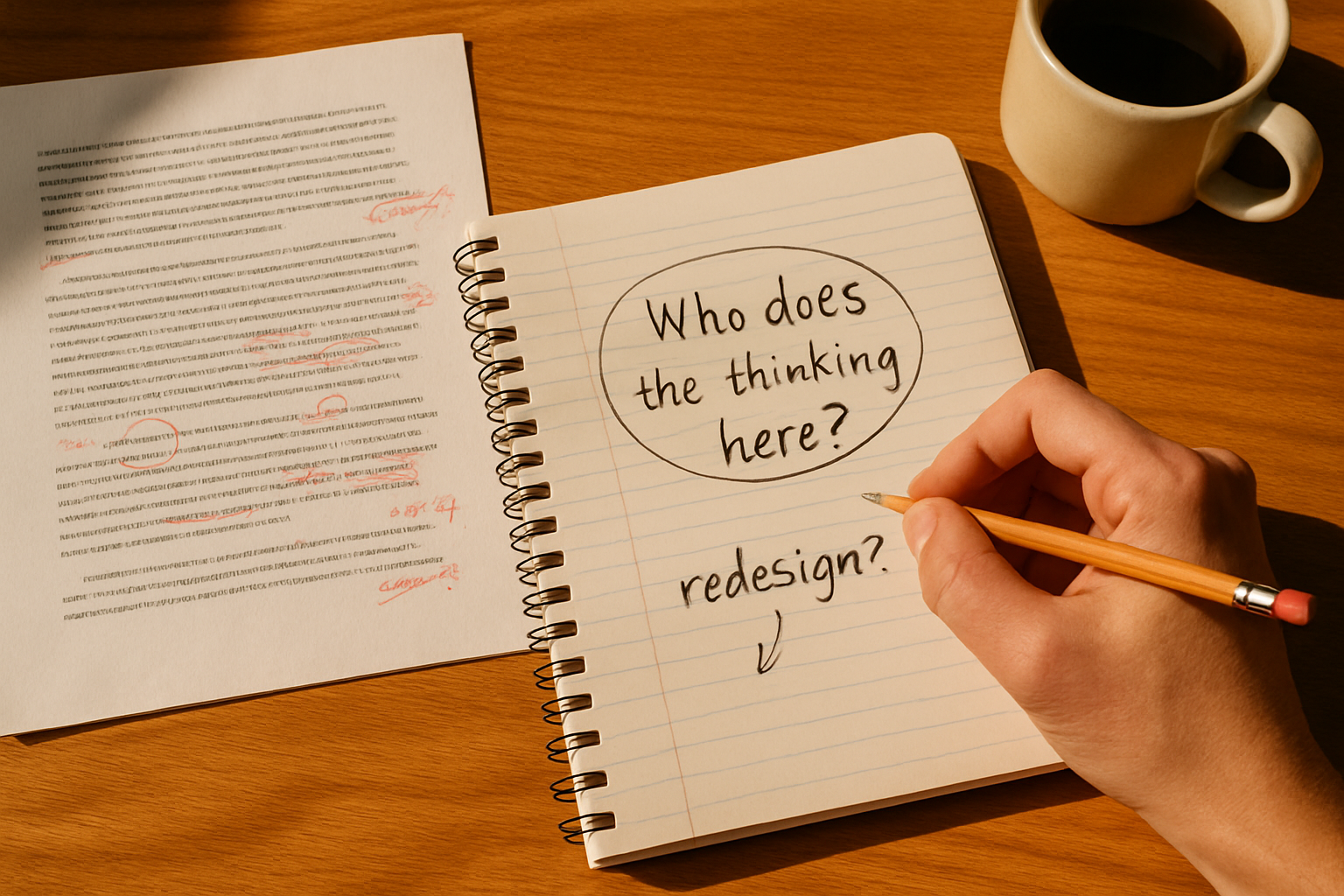
This is the insight that changes the way I think about assignment design now. The question to ask is not “how do I make this AI-proof?” Because the honest answer is that you cannot. AI-proof assignments do not exist. The question is: could a student submit a generic AI response and receive a passing grade? If the honest answer is yes, that is not a student ethics problem. It is a design problem. And design problems have design solutions.
The solution is not to ban AI. The solution is to design around the gap.
What fills the gap? Evidence of actual thinking. That looks different depending on your discipline. In design, it might be process documentation. Not the rationale, but the working file showing the iterations before the final choice. In writing, it might be a recorded explanation of why one paragraph ends where it does. In any field, it might be specificity. A response that references something that only exists in this classroom, with this particular project, against these particular constraints.
AI cannot fake what it was not there for.
The iterative close-the-loop step I now use: after I revise an assignment based on the adversarial question, I paste the revised version back in and ask the question again. Not to be paranoid. To confirm that the revision actually closed the gap, and not just moved it. This second pass often surfaces a secondary gap I had not noticed.
Here is what I tell people when I walk them through this technique. The goal was never to make assignments AI-proof. The goal was always to require evidence of actual thinking. AI did not change that goal. It just removed the assumption that traditional formats were achieving it. Some of them were. Some of them were not, and we did not know because the gap had never been exposed.
The visible requirements are not the work. The actual thinking is the work.
This applies outside education. Before you deploy any system, any process, any workflow where someone needs to actually do the work, ask the adversarial question: how could someone go through the motions of this and satisfy the visible requirements without doing the actual thing? Then build around that. They have always been different things. AI just made the difference harder to ignore.
The assignment that took me years to build the right way took one uncomfortable evening to fix.
That is a fair trade.
About This Post
I have been doing faculty AI training sessions, and the most unsettling thing I keep discovering is not what AI can do. It is what our existing assignments were not doing. When I ran the adversarial test on my own work, pasting an assignment into AI and asking how a student could complete it using a generic response, what came back was a specific description of a design gap I had never noticed. The assignment looked like it required thinking. It did not. I have spent years teaching design, which means I have spent years believing that if you build the right assignment, students build the right skills. AI forced an honest answer to a question I should have been asking all along: is this assignment actually requiring the thing I think it is requiring? This post is for anyone who builds systems that depend on people doing real thinking, and who might want to know whether the system is actually demanding it.
— Greg Williams, design instructor