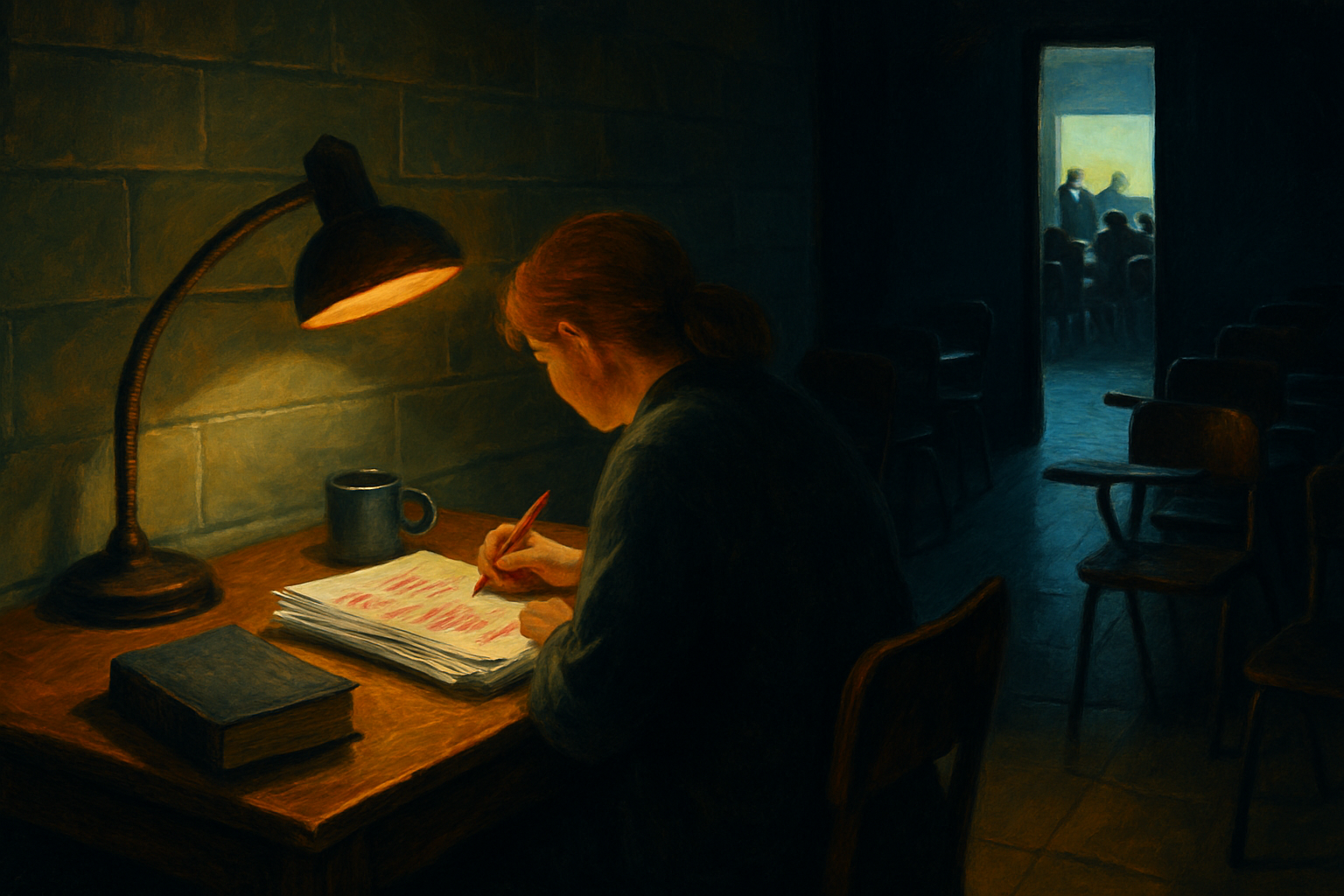
Mr. Burke taught chemistry and physics at Hargrave Military Academy. He also walked the dormitory halls during evening study hours, which was not in his job description. He ate in the mess hall with cadets, which was not in his job description either. He knew which students were struggling, not just with molar mass but with everything else happening in their lives, and he showed up in those places specifically, because he seemed to understand that was where the teaching actually happened. I had Mr. Burke for chemistry and I can tell you honestly that I do not remember much about equilibrium reactions. I remember that he showed up. I remember that it mattered. I remember that it changed what I thought a teacher was.
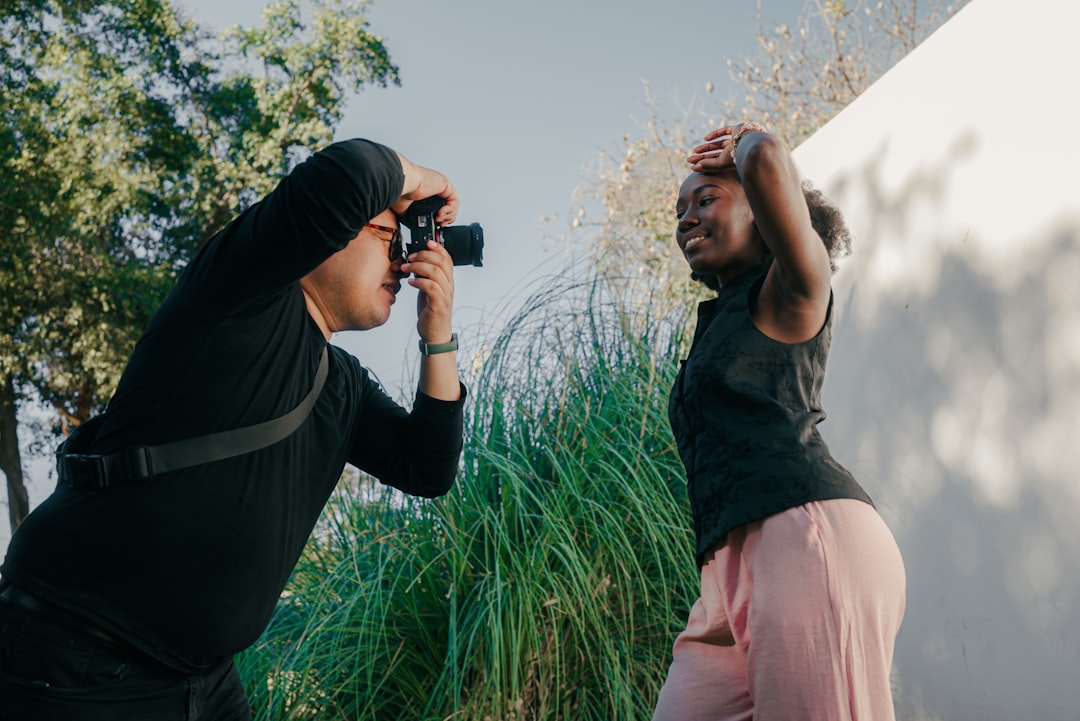
Coach Klein ran Fellowship of Christian Athletes and the honor council. Mr. Ramsey was my math teacher and the yearbook sponsor who let me spend afternoons in the darkroom even when I had nothing to photograph because he knew I needed somewhere to be. Reverend Cohen talked to students about things that had nothing to do with religion. These were not remarkable human beings in some cosmic sense, they were working educators at a military boarding school in Virginia, but every single one of them gave me something that a textbook cannot give you, that a lecture cannot give you, that a beautifully organized digital platform absolutely cannot give you, and that is the experience of being known. Of having someone see the whole of you, not just the part that showed up to turn in the assignment.
I have been thinking about this a lot lately as everyone argues about what AI means for faculty, and I want to tell you something that I think gets missed in most of that conversation. The teachers who are truly irreplaceable were never doing what people imagine AI is threatening to replace. They were never information delivery devices. The ones I remember, the ones who changed my life, were doing something else entirely, and they were doing it on purpose, and that thing is not automatable.
Now, to be fair, there were teachers at that school who were the other kind too, who covered material and called it teaching, who handed back papers without conversations, who had never once asked “how are you doing” in a way that invited a real answer. I am not going to pretend those teachers weren’t there. And here is the thing: if AI had been available then, those teachers would have been redundant. Not because technology advanced but because they were already operating as information delivery systems, and information delivery systems can be replaced by better information delivery systems. They always could have been. AI just made it obvious.
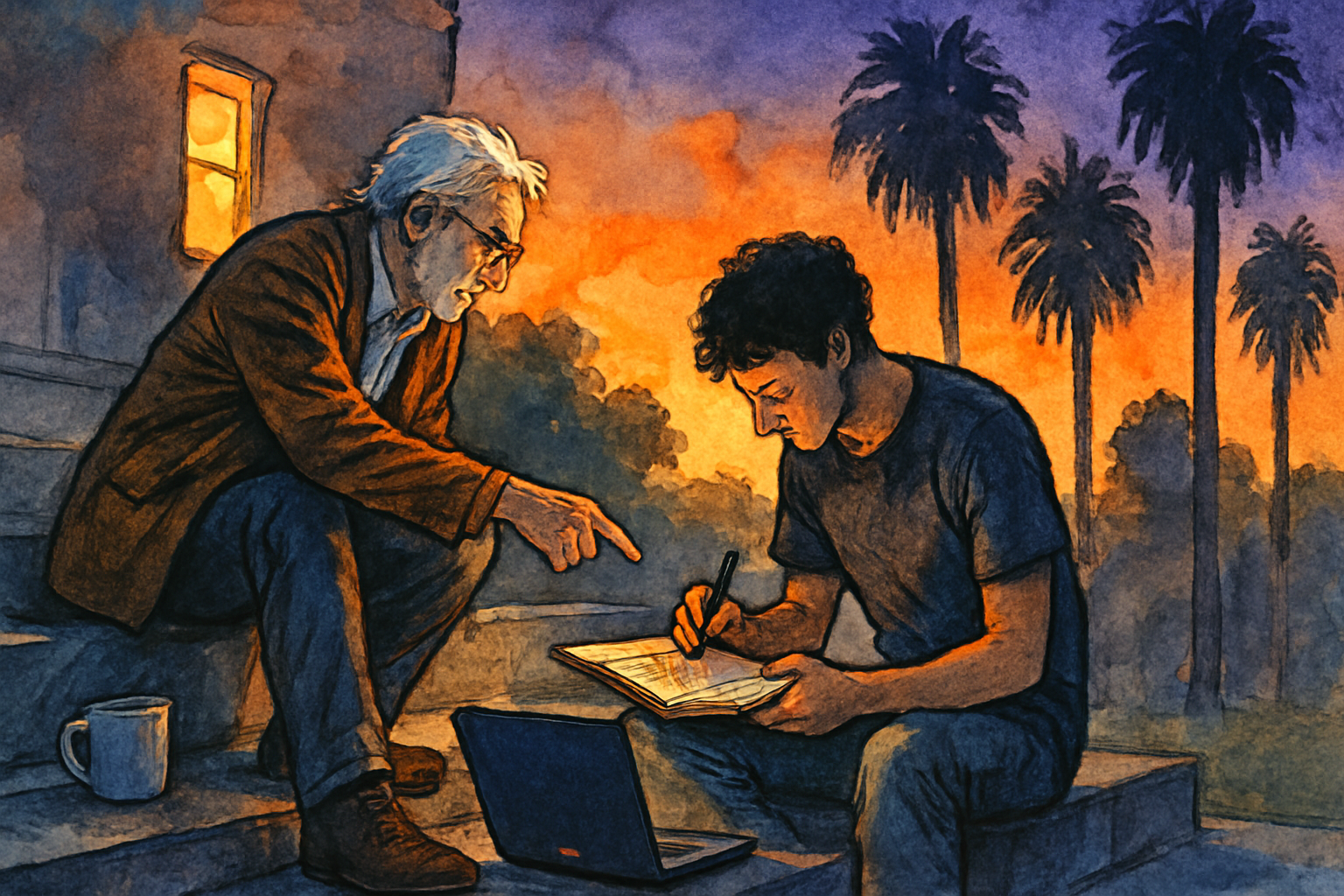
I didn’t become a teacher until I was thirty-nine and a half. A woman named AJ Chase found me in a parking lot, well, in the building where my father worked, and she said, “Would you do us a favor and teach a class?” I had lost everything a year or two before that. The business, the marriage, the house, access to my kids, all of it gone in about three months. I wasn’t going anywhere. I wasn’t anyone particular at that moment. And she looked at me and saw something worth asking. That is a specific, human, relational act. She wasn’t running an algorithm that flagged my credentials. She saw a person and made a judgment about what that person might offer someone else. That is what the good ones do.
Twenty-five years in, I still think about that. Because the students who came through my classes were usually not there for Photoshop shortcuts. I mean, yes, they needed to learn the software, and I taught them the software, but the students who stayed in my memory were the ones who needed someone to see them the way AJ Chase saw me. I had a student once whose husband enrolled her in school specifically because he was certain she’d fail. She stopped talking about it and just started working. She got pregnant, and he thought that was his chance to make her quit. She had a C-section on a Friday and was back in class on Monday. Her grandmother watched the newborn. She freelanced from home for three years after that, won awards, built a real client list, and eventually left him. I have a thousand stories like that. You don’t get those stories from faculty who are covering material. You get them from faculty who are showing up.
The argument you hear is that AI can now deliver information better than most professors. Fine. True. An AI can synthesize a field of knowledge, present it clearly, answer follow-up questions, adapt to learning pace, and be available at two in the morning without complaining. If your model of teaching is “I am the person who knows the thing and you are the person who does not know the thing and I will transfer the thing to you,” then yes, your job is in real trouble. But I would push back gently and say: your job was always in trouble. It was a mediocre model before AI. AI just made mediocre models visible.
The roles that are becoming more important in the AI era are the roles that were always important and often undervalued. The faculty member who does the intellectual labor of asking, “why does one student come in overflowing with ideas while twenty others sit there staring at a blank screen?” and then spends years working out an answer. The faculty member who takes the new platform the students are obsessed with, and instead of banning it, turns it into a curriculum tool. I used to do that with MySpace when students couldn’t stay off it, and it was the best CSS lab I ever built, because they actually cared about the output. The faculty member who knows when a student is drowning not because the work is late but because something in how they’re sitting is wrong. These are skilled, trained, deeply human capacities, and they don’t get weaker in the age of AI. They get more essential.
I started seriously thinking about what creativity is and how it works during a three-week break from teaching in December 2019, and the question that launched everything was this: why do some students generate ideas effortlessly while others shut down? That question is not answerable by an AI. It required me to know the students, and to know teaching, and to have enough respect for both that I kept pulling at the thread until I had something worth using. Two years of research, 650 exercises built from that research, and then five more years of testing them in real classrooms. AI helped me do the research faster. It did not ask the question. That question came from twenty years of watching people struggle in rooms I was responsible for.
Here is what I want to leave you with, because I am not interested in reassuring anyone who is coasting. If your value as a faculty member comes entirely from possessing information your students don’t have, you need to do some hard thinking. That gap is closing and it is not coming back. But if your value comes from being present, from knowing your students as whole people, from asking the question nobody has asked yet and staying with it until the answer is useful, from being the AJ Chase in someone’s parking lot, then the AI era is not a threat to you. It is a sorting mechanism. And the ones who survive it were always the ones who were doing the thing that actually mattered.
For Further Reading
On faculty, presence, and what technology can and can’t replace in a classroom:
- AI Empowers the Thinkers — The anchor piece on why AI amplifies strong thinkers and exposes weak ones — same argument, from the student’s side of the desk.
- The Question That Fixed My Worst Assignment — What happens when a faculty member uses AI to stress-test their own teaching instead of hiding behind it.
- Your AI Tool Is Optimized to Sound Like It’s Done — Why AI tools are built to finish, not develop — and why that’s a teaching problem, not a technology problem.
- You Can’t Teach Making by Explaining It — The part of learning that requires presence, not just information — which is exactly what this post is about from a different angle.
- The C Student Who Outworked the A — What grades actually measure, and why the teachers who saw beyond them were always the most important ones in the room.
- Meeting You Where You Are — The teaching philosophy that runs underneath everything: find where the student actually is, then build from there.