Exercise 3 of 20 from the Playing With Purpose Student Edition
From Book 2: The Spark (Exercises in Curiosity)
The Parable
Richard Feynman watched a student toss a plate in the cafeteria. It spun and wobbled as it fell. He became fascinated by the wobble. It looked like it was precessing. He connected it to quantum electrodynamics, a field where he was already working. Most people saw a plate. Feynman saw a whole branch of physics. But first he had to make an absurd connection. Plate spinning and the invisible laws of atoms are not obviously related. Yet the connection was real, and it led somewhere.
You think connection-making requires seeing what’s similar. You think it’s about finding the thread that ties things together. Wrong. The best connections come from finding genuineness in what appears absurd. That’s where the novelty lives.
The Exercise
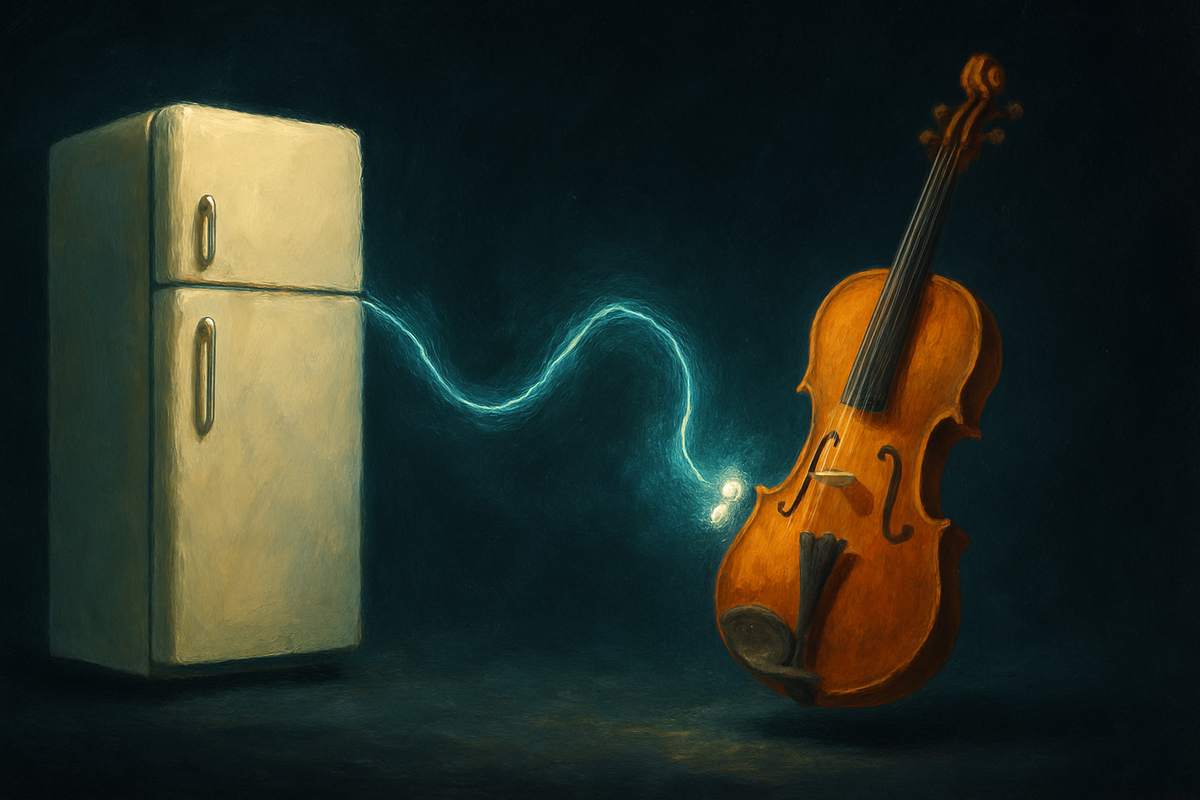
Choose two things with nothing in common. Not two kinds of fruit. Not two tools. Two things from completely different domains. A refrigerator and a waltz. A theorem and a sneeze. A mirror and a rumor. A doorknob and a melody. Write them down. You should feel a small resistance. This is good. It means you picked well.
Now find a genuine, non-trivial connection between them. Not a poetic metaphor. Not a forced comparison. A real structural or functional similarity. If you chose refrigerator and waltz: both have rhythm. The fridge cycles. The waltz counts in threes. Keep cycling. Both have a temperature range where they function. The fridge needs cold. The waltz needs a specific tempo. Both have people who enter and leave them. Both create a contained space with rules. Give yourself five minutes. When you find the connection, you’ll recognize it. It will feel like you discovered something true that was always there.
Reflection Questions
1. How long did it take before the connection felt real instead of forced?
2. Did the connection surprise you, or did it feel obvious once you found it?
3. Could someone else find a different genuine connection between the same two things?
4. What did this exercise reveal about how you usually see similarity and difference?
What We Were Trying to Do
Roald Dahl and Richard Feynman both understood that imagination is not about making things up. It’s about finding genuine patterns that your habitual mind missed. The connection was there before you found it. You didn’t invent it. You noticed it. Your task was to see like a person who hasn’t been trained to see separation between domains. In that seeing, you access a different kind of thinking.
Why It Matters
Most innovation comes from connecting what exists in one domain to a problem in another. The connection feels absurd at first. That’s the signal that you’re seeing something real that others missed. When something feels obviously connected, a thousand people have already made that connection. When it feels absurd, you’re in new territory.
This matters because it trains you to see beyond the obvious categories. You learn that a refrigerator and a waltz are not as different as they first appear. That similarity-in-difference is where creative breakthroughs happen. You start asking: what else is more similar than it appears? This becomes a habit of mind. It becomes how you think about problems.
You’ll use this in conversations, design, problem-solving, any domain that requires fresh thinking. Someone says the problem is unsolvable. You ask: what does this resemble? What field has already solved this, even though it doesn’t look related? The absurd connection is the moment when you step outside the problem’s usual frame and see it as something you’ve seen before, somewhere else.
References & Further Reading
Richard Feynman’s approach to creative thinking (Feynman, Richard P., ‘Surely You’re Joking, Mr. Feynman!’, W.W. Norton, 1985) demonstrates how cross-domain pattern recognition generates scientific insight; his discovery of QED breakthroughs came from observing the wobbling plate and connecting it to theoretical physics. Roald Dahl’s creative process (Dahl, Roald, ‘More About Boy’, Farrar, Straus and Giroux, 2008) shows how imagination works by making unexpected associations between disparate elements. Boden and others’ research on conceptual blending (Boden, Margaret A., ‘The Creative Mind’, Oxford University Press, 2004, Ch. 6-7) establishes that creative insight emerges from the combination of concepts from different conceptual spaces, with the tension between apparent incongruity and discovered similarity generating novel ideation.
Going Further
This exercise gets easier with practice, but not easier in the way you’d expect. You get faster at recognizing genuine connections. You become more tolerant of the initial absurdity. You start to see that almost any two things have real patterns in common if you look past the surface. This is a fundamental shift in how your mind works.
Try this with colleagues, students, or friends. Make it a game. Take two absurd pairings and compete to find the most unexpected genuine connection. The person who finds the most surprising true similarity wins. What makes a connection ‘surprising’ is that it was true all along and nobody noticed. You weren’t clever. You were attentive.
Use this when you’re stuck on a problem. Pick something completely unrelated. A musical instrument if you’re designing a space. A garden if you’re writing code. A migration pattern if you’re planning an organization. Ask: what does this problem resemble? What genuine pattern does it share with something from a completely different world? The answer you find will reframe everything you thought you knew.
This exercise is from the Playing With Purpose Student Edition by Greg Williams. The complete series of 650 exercises across 10 books is planned for publication in summer 2026.
This is practice. Nobody will grade this.