Exercise 4 of 20 from the Playing With Purpose Student Edition
From Book 2: The Spark (Exercises in Curiosity)
The Parable
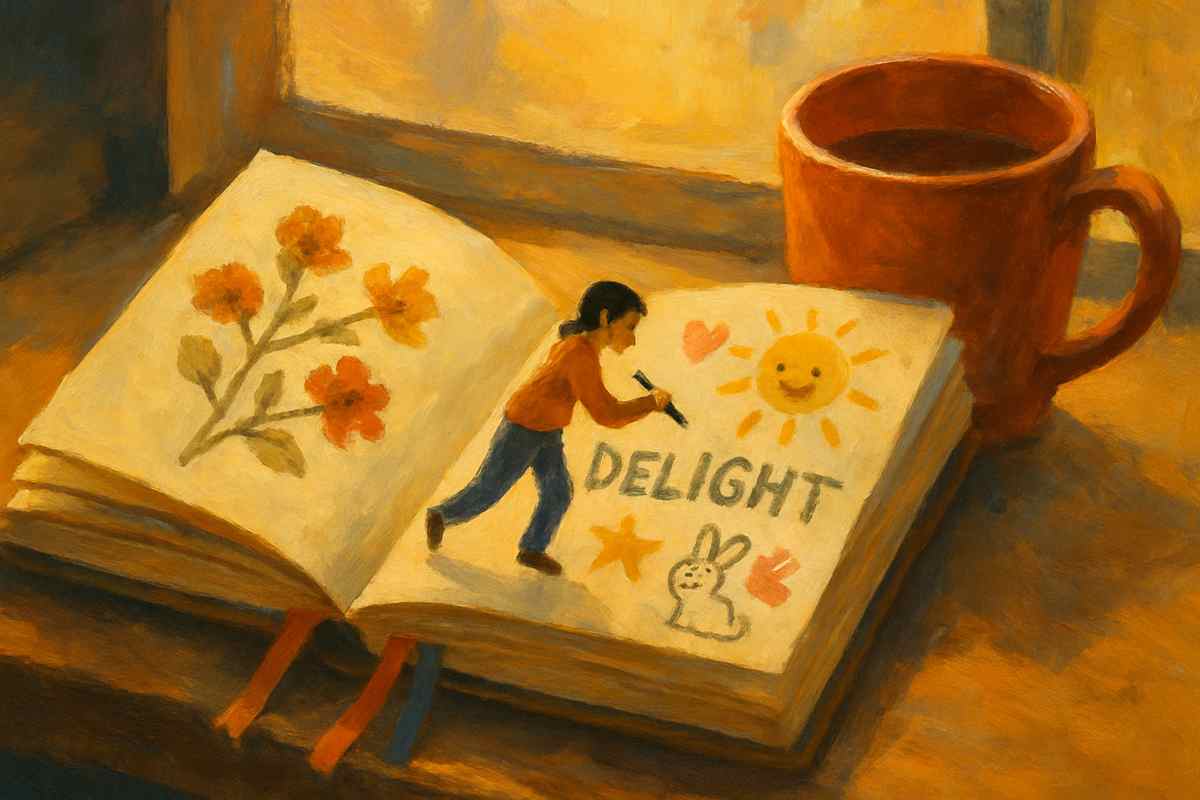
A man sat with a journal and the instruction to write one thing that delighted him each day. Not something that made him happy. Not something that impressed him. Something that created delight. A specific delight. The word itself became his teacher. Day one: the precise moment when a dog’s ear flapped at the exact moment of a honking horn. Just the timing. Day two: a shadow pattern through a tree onto a white wall, moving slowly as the sun moved. Day three: his daughter saying something he’d never heard her say before. He wasn’t looking for big things. He was looking for the texture of joy in small moments.
Delight is not happiness. It’s not satisfaction. It’s that specific moment when you feel surprise and rightness at the same time. When something perfectly meets what you didn’t know you were looking for. Most people miss delight because they’re not looking for it. This week, you’re going to become an expert at delight.
The Exercise
For seven days, write one thing per day that delighted you. Not satisfied you. Not impressed you. Delighted you. The specific quality matters. Reread Ingrid Fetell Lee’s definition if you need clarity. Delight is surprise plus recognition. It’s something that makes you feel, as she says, ‘found.’ Write it down. A sentence or two. What was it? Why did it delight you, specifically? What texture did it have?
At the end of the week, reread your seven entries. Look for patterns. What kinds of things delight you? Is it visual pattern? Unexpected kindness? The specific moment of a transition? Wordplay? The texture of a material? Your delight diary is a map of your personal delight landscape. It shows you what your deepest self is drawn to. These patterns are not trivial. They’re clues to what matters most to you. They’re clues to what you should create.
Reflection Questions
1. What surprised you most about what delighted you throughout the week?
2. What patterns did you notice in your seven entries?
3. Were there moments you thought were delightful but didn’t feel delightful when you wrote them down?
4. How does knowing your delight landscape change what you pay attention to?
What We Were Trying to Do
Ingrid Fetell Lee studies delight. Rumi wrote about it in poetry. Both understood that delight is a form of knowledge. It’s your deepest self recognizing what aligns with its actual values. Not what you think you should value. What you actually do value. Most people’s lives are built on should. This exercise helps you build on the actual delight that moves you. That’s where your real work lives.
Why It Matters
You cannot create for an audience. You can only create from what delights you. When you understand what delights you, you understand your actual values. Not your stated values. Your actual ones. That clarity is everything. It’s the difference between work that’s technically good but feels hollow and work that feels true because it comes from your genuine delight.
This matters because delight is contagious. When you create from what delights you, other people feel it. They recognize in your work the signature of genuine joy. That’s what they want. Not perfection. Not cleverness. Authenticity. The specific texture of joy that only you can bring. Your delight diary teaches you what that texture is.
The week of attention also changes your entire experience of daily life. You stop living habitually. You start noticing. You become attuned to moments that would have passed unnoticed before. A shadow. A word. A texture. A timing. The world becomes more legible. More interesting. More alive. That aliveness is where the best creative work originates.
References & Further Reading
Ingrid Fetell Lee’s research on delight (Fetell Lee, Ingrid, ‘Joyful: The Surprising Power of Ordinary Things to Create Extraordinary Happiness’, W.W. Norton, 2018) establishes delight as a distinct form of positive emotion characterized by surprise, recognition, and the precise alignment of expectation and experience. Rumi’s poetic exploration of joy and recognition (Rumi, Jalal ad-Din, ‘The Essential Rumi’, translated by Coleman Barks, HarperCollins, 1997) demonstrates that authentic creative expression emerges from alignment with what genuinely moves the artist. Csikszentmihalyi’s research on flow and intrinsic motivation (Csikszentmihalyi, Mihaly, ‘Flow: The Psychology of Optimal Experience’, Harper Collins, 1990) shows that creative work sustained by intrinsic delight (rather than external reward) generates both superior outputs and sustained creative development.
Going Further
Many people struggle with this exercise because they’ve been taught not to value joy. They think delight is trivial. It’s not. Delight is data. When something delights you, it’s telling you truth about what aligns with your actual nature. The opposite of delight is obligation. All creative people eventually face the choice between doing what they think they should do and doing what delights them. The people who choose delight consistently create better work.
You can extend this exercise beyond one week. Keep the delight diary indefinitely. Over months and years, patterns will emerge more deeply. You’ll see how your delight landscape evolves. What once delighted you might still, or it might shift. That shift is meaningful. It’s you becoming more yourself. Paying attention to that evolution is how you stay aligned with your actual values rather than your historical ones.
Use your delight diary when you’re deciding what to create next. Stuck on a project? Feeling obligated to something that doesn’t move you? Go back to your delight entries. Ask yourself: what delight am I missing in this work? How could I introduce that texture? What would need to change so this work contained what actually moves me? The diary becomes your creative conscience. It keeps you honest about whether you’re creating from obligation or from the only place that matters. Genuine joy.
This exercise is from the Playing With Purpose Student Edition by Greg Williams. The complete series of 650 exercises across 10 books is planned for publication in summer 2026.
This is practice. Nobody will grade this.