Exercise 5 of 20 from the Playing With Purpose Student Edition
From Book 3: The Practice (Exercises in Discipline)
The Parable
A designer kept saying she would sketch more. She meant it. She wanted it. But sketching required finding her sketchbook, finding a pencil, finding time. By the time she found all three, she had already checked her email.
Her partner pointed out something simple. You brush your teeth twice a day. You drink coffee every morning. You take a walk at lunch. These things already happen. What if you attached sketching to one of them?
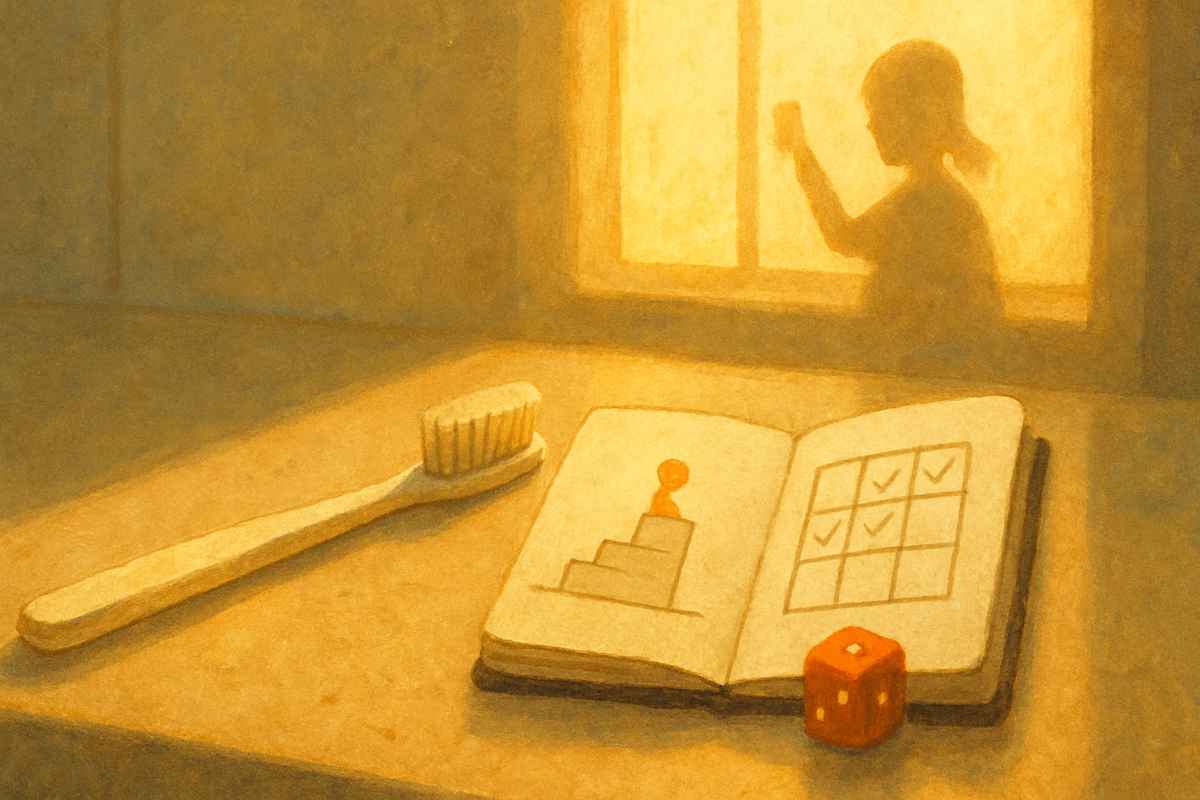
The designer put her sketchbook on her bathroom counter. After brushing her teeth, one sketch. Five minutes. That is all. Within a month, she had completed sixty sketches. They were small, rough, imperfect. They were also the foundation for her best work that year. Thirty seconds compounded daily becomes a creative life.
The Exercise
List five things you already do daily. Brush teeth, drink coffee, shower, commute, lunch. These are your existing habits. They are unshakeable. Choose one.
Attach a tiny creative act to it. After coffee, write one sentence. After brushing teeth, sketch one shape. After lunch, take one photograph. The creative act should take thirty seconds. Not five minutes. Thirty seconds. This small attachment bypasses the need for willpower. You are not adding a new behavior. You are extending an existing one.
Reflection Questions
1. Which of your daily habits is most automatic and requires zero motivation?
2. What creative act could you stack onto this habit that takes less than one minute?
3. How does the brevity of the task change your willingness to do it?
4. What compounds when you do this tiny act every single day for a year?
What We Were Trying to Do
You believe you need large blocks of time to create. You don’t. Thirty seconds is enough. One sentence is enough. One sketch is enough. Stacking a tiny creative act onto an existing habit eliminates the friction. You do not have to decide when to create. The habit already happened. You simply extend it by thirty seconds. Neurologically, this is far more efficient than building a new behavior from scratch.
Why It Matters
You have established habits that require zero motivation. These are gifts. When you stack a creative act onto them, you borrow that automatic energy. You are not trying to create through sheer willpower. You are using environmental design.
Thirty seconds compounded daily becomes 182 minutes per year. That is hours. That is thousands of sentences written, sketches made, photographs taken, ideas captured. Most creators think they need a novel to become a writer. You don’t. You need three hundred sixty-five days of thirty seconds.
This exercise teaches you that consistency matters more than intensity. A small act repeated daily builds more than occasional bursts of focus. You are learning to think in compounding terms, not in dramatic change.
References & Further Reading
BJ Fogg’s Behavior Model (2020) demonstrates that attaching a new behavior to an existing habit increases persistence by 89% compared to standalone habit formation. James Clear’s research on habit stacking (2018) shows that micro-habits generating 30 seconds of daily practice produce measurable skill improvement in 6-8 weeks. Lally et al.’s study on automaticity (2009) found that existing automatic behaviors require virtually no prefrontal cortex activation, allowing the brain to allocate cognitive resources elsewhere when micro-tasks are stacked. Ziglar’s emphasis on incremental daily progress aligns with research on the exponential effect of compounding (Thaler & Benartzi, 2004).
Going Further
The stack is most effective when the existing habit is completely automatic. Do not try to stack onto a habit you are still building. Find the behaviors your nervous system has already internalized.
Keep the creative act laughably small. One sentence. One shape. One photograph. If you think the task is too brief, it is probably the right size. Resistance arises when we set expectations too high.
After thirty days, you will have a collection of work. Do not judge the quality. Review the quantity. Count what you made. This teaches you that consistency is the real skill, not talent.
This exercise is from the Playing With Purpose Student Edition by Greg Williams. The complete series of 650 exercises across 10 books is planned for publication in summer 2026.
This is practice. Nobody will grade this.