Exercise 6 of the Playing With Purpose series
The Exercise
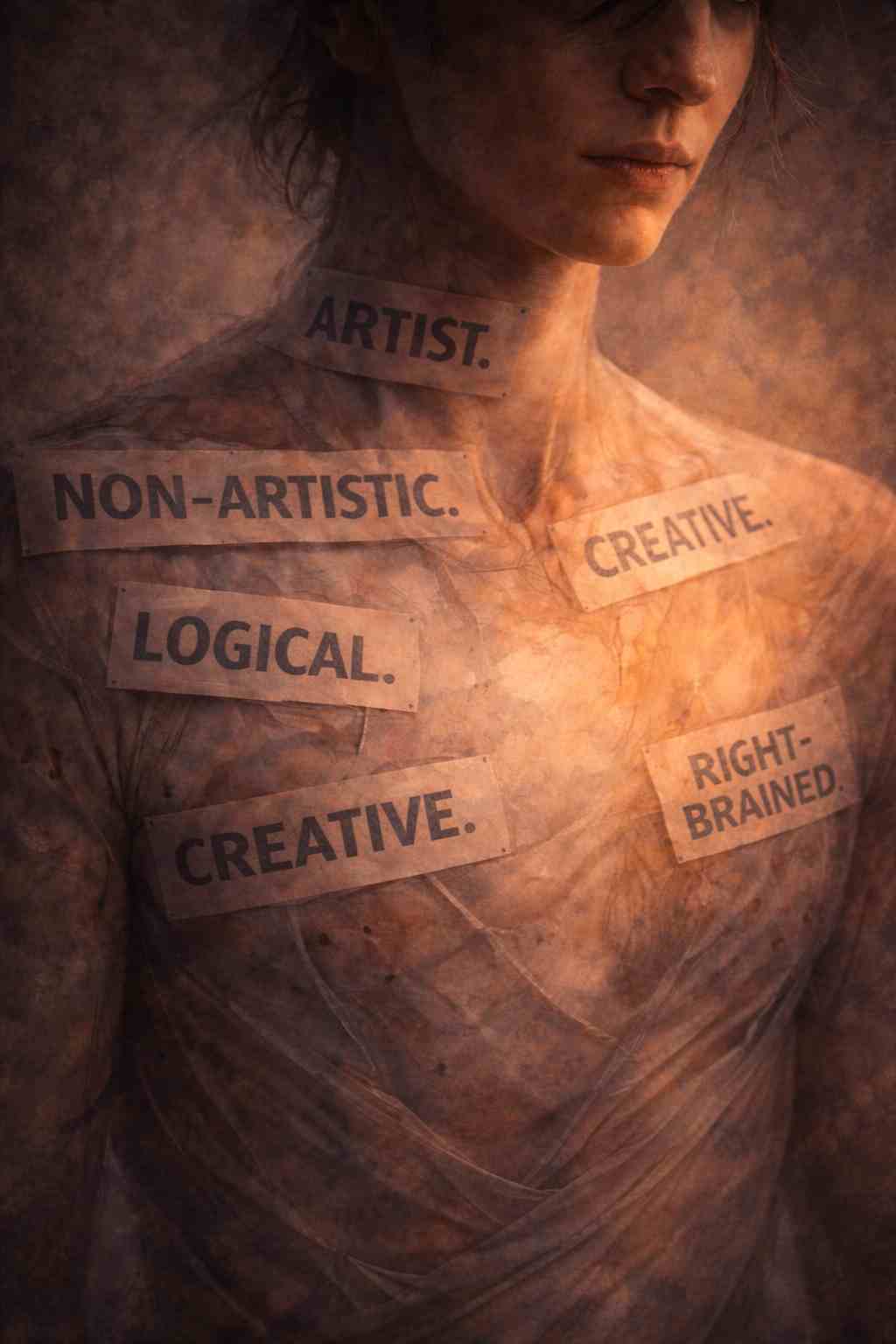
Write down every creative label you’ve ever accepted about yourself, positive or negative. Artist. Non-artistic. Musical. Tone-deaf. Creative. Logical. Right-brained. Left-brained. Good with words. Bad at drawing. Write them all, the ones you claimed proudly and the ones you accepted because someone assigned them to you and you didn’t argue.
Now look at each one and ask: is this actually true, or is this the category I ended up in because no better language was available?
Then answer these:
The reflection questions:
- Which of these labels expanded your sense of what you could do? Which ones contracted it?
- Have you ever done something that didn’t fit your label and quietly not counted it?
- What would you call yourself if you had to start from scratch with no prior categories?
- Is there a version of creativity you’ve been practicing all your life that just wasn’t called by that name?
- What becomes possible if you replace the inherited label with a more accurate one?
What I Learned When I Did This
For a long time, the labels ran like this: not an artist, technical, logical, good at solving problems, bad at making things. I built a professional identity around those terms and they weren’t entirely wrong, they just weren’t the whole picture, and the parts they left out were the parts I kept running into without having language for.
The reframe came slowly, over years, through teaching. I started teaching graphic design in my late thirties and almost immediately I could see that the students who were struggling weren’t struggling because they lacked creativity, they were struggling because they didn’t have a process. They had ideas, sometimes very good ones, but they didn’t have a systematic way to take an idea from a feeling in the gut to a resolved, communicable piece of visual work. And I realized that this was what I actually did. Not art-making. Not self-expression in the way the word “creative” usually implies. Problem solving. Systematic, rigorous, research-driven, analytically-informed visual problem solving.
Once I had that language, the label “not creative” started looking like a category error. The teacher who told me I had no artistic talent when I was nine years old was probably right that I wasn’t making the kind of expressive, emotionally-driven, intuition-first work she associated with art. But design isn’t that, or it isn’t only that, and the ability I had, which was to look at a problem and build a systematic path from the mess of the problem to a resolved visual answer, that’s not a lesser creativity. It’s a different one. It just didn’t have a name in the fourth grade.
I didn’t call myself a designer until I was fifty years old. I’d been doing the work for over a decade at that point, teaching it, publishing about it, building curricula around it, and I still defaulted to the old inadequate categories because they were what I had and what I’d carried and what felt honest. Claiming the word “designer” felt like a reach, like I might be overstepping into something I hadn’t fully earned. And then one day I sat down and tried to explain exactly what it is that I actually do, and the explanation matched the definition of design so precisely that the resistance just ran out of justification.
The thing about labels is that they’re inherited before they’re chosen. You’re young, someone with authority speaks, you accept the category because you don’t know you can negotiate it. And then the category starts doing work you never asked it to do, filtering what you try, what you claim, what you give yourself permission to pursue. The exercise I’d put in front of anyone doing this kind of reflection is: stop letting the original label make decisions for you. It was provisional. It was someone else’s limited observation on a day when they couldn’t see very much. Go back, look at what you’ve actually done with your actual life, and figure out what to call it now.
You might be surprised how much more interesting the true name is.
Playing With Purpose is a series of creativity exercises for people who want to understand and reclaim their creative capacity. You don’t need to be an artist. You need to be curious.
Further Reading
- Ideation for Everyday Design Challenges (NN/g) — Practical ideation methods for generating ideas
- Design Thinking 101 (NN/g) — Foundational overview of design thinking
- What Is Creativity? (IxDF) — Foundations of creativity and creative thinking