Exercise 7 of the Playing With Purpose series
The Exercise
Think about the hardest thing you’ve been through, the thing that fundamentally changed what you thought your life was going to look like. The loss, the failure, the moment where the plan you’d been executing stopped being a plan you could execute. You don’t have to go all the way into it if it’s too recent. But if there’s enough distance that you can look at it without being inside it, go there.
Write about what you thought your life was going to be on the day before it happened. Then write about what your life actually became.
Then answer these:
The reflection questions:
- What did the collapse take from you that you thought defined you?
- What did it reveal about you that the good times had kept hidden?
- What did you build in the aftermath that you couldn’t have built from the comfortable version of your life?
- Who did you become on the other side that you couldn’t have become any other way?
- If you had to find one thing the collapse made possible, what would it be?
What I Learned When I Did This
I was 38 years old. I had what looked like a life. A business, a marriage, a house, a sense of forward momentum, all the external markers of someone who had figured it out. And then, over a period of time that felt simultaneously very long and very sudden, all of it went. The business collapsed. The marriage ended in divorce. The house went with it. Access to my daughters, daily access, the kind where you’re just there, went with it too. I moved back into the back of my parents’ house with not enough money to live on my own, and that is where I was at 38 years old, which was supposed to be a settled, smooth, productive decade, the one where you cash in on all the work you did in your thirties.
I want to be honest about what that period actually felt like, because the temptation in telling a story like this is to move quickly to the lesson, to the turning point, to the version where you can see that it all worked out. And it did work out, eventually, but I didn’t know that while I was living it, and glossing over what it actually felt like would be dishonest and also useless to anyone reading this who is somewhere in the middle of their own version of it.
It felt like erasure. The things I’d been using to understand who I was, the business, the role of husband and father in a particular household with a particular daily rhythm, the professional identity I’d constructed over years, all of it was gone at the same time. And what was left was just me, without the scaffolding, which was disorienting in a way that’s hard to describe to someone who hasn’t experienced it. You don’t realize how much of your sense of self is built from external structure until the external structure disappears.
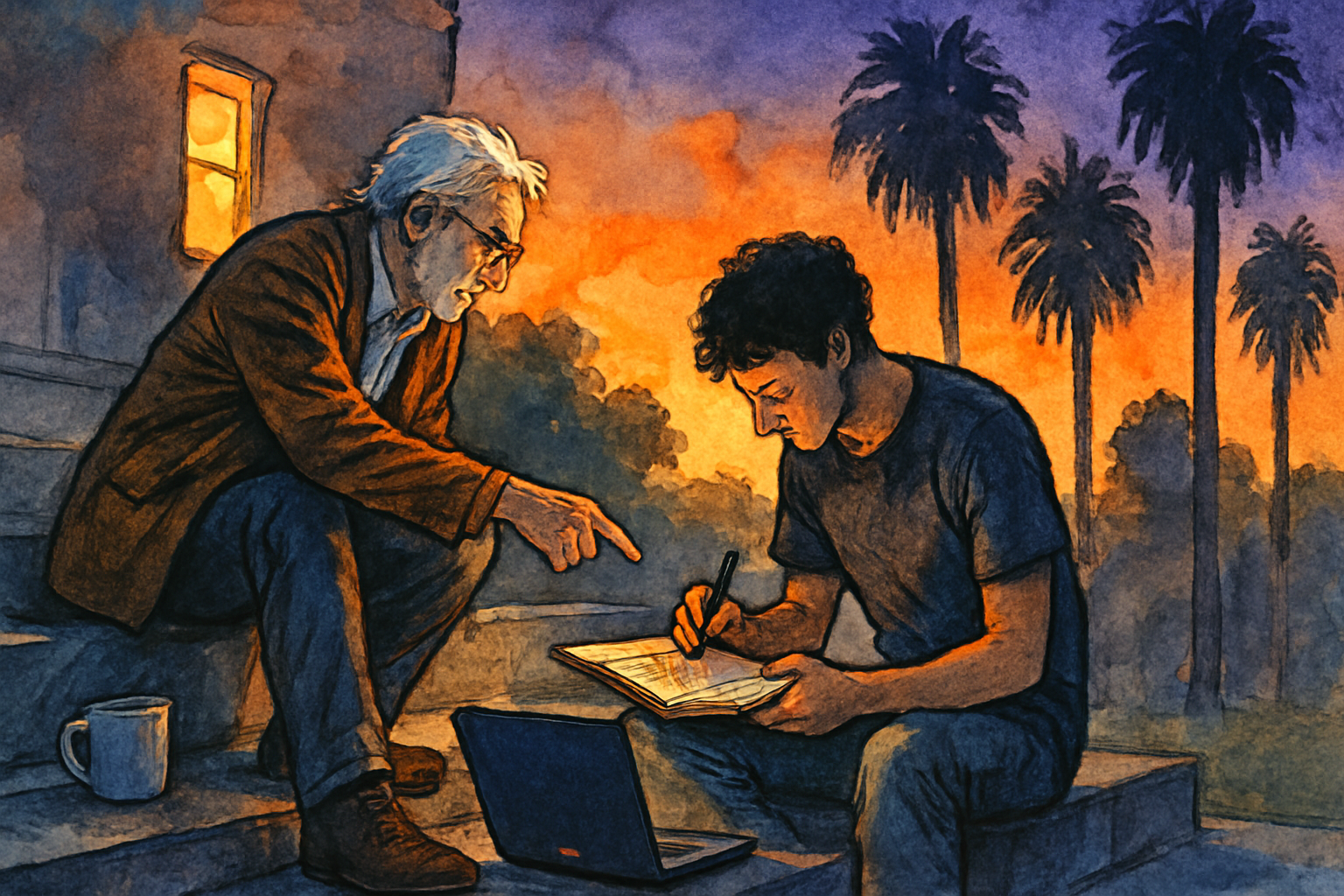
What saved me, and I say saved me quite literally, was my parents’ house and my parents’ presence, and then teaching. I started teaching graphic design almost by accident, at 39 and a half, as a way to earn income doing something I knew. And what I discovered, and I did not expect this at all, was that teaching fed something I hadn’t known was hungry. The problems my students brought me were the most interesting problems I’d ever worked on. The challenge of figuring out how someone learns, how to explain a concept twelve different ways until one of them lands, how to watch a student get stuck and find the exact question that unsticks them without doing it for them, this was genuinely fascinating work. I had found what I was supposed to do by losing everything I thought I was supposed to be.
I’m not going to tell you that the collapse was a gift, because it wasn’t, and I distrust the version of these stories that makes the suffering sound retroactively necessary in a tidy way. But I will tell you what’s true: the person who walked into a classroom at 39 and discovered he was built to teach design could only have been built by that specific sequence of events, including the hard ones. The version of me that had the comfortable business and the intact marriage and the settled life did not have what the teaching required. The floor had to drop first.
The question I’d put to anyone doing this exercise is not “what did you lose?” You know what you lost. The question is: what showed up after the losing that couldn’t have come any other way?
Playing With Purpose is a series of creativity exercises for people who want to understand and reclaim their creative capacity. You don’t need to be an artist. You need to be curious.
Further Reading
- Ideation for Everyday Design Challenges (NN/g) — Practical ideation methods for generating ideas
- Design Thinking 101 (NN/g) — Foundational overview of design thinking
- What Is Creativity? (IxDF) — Foundations of creativity and creative thinking