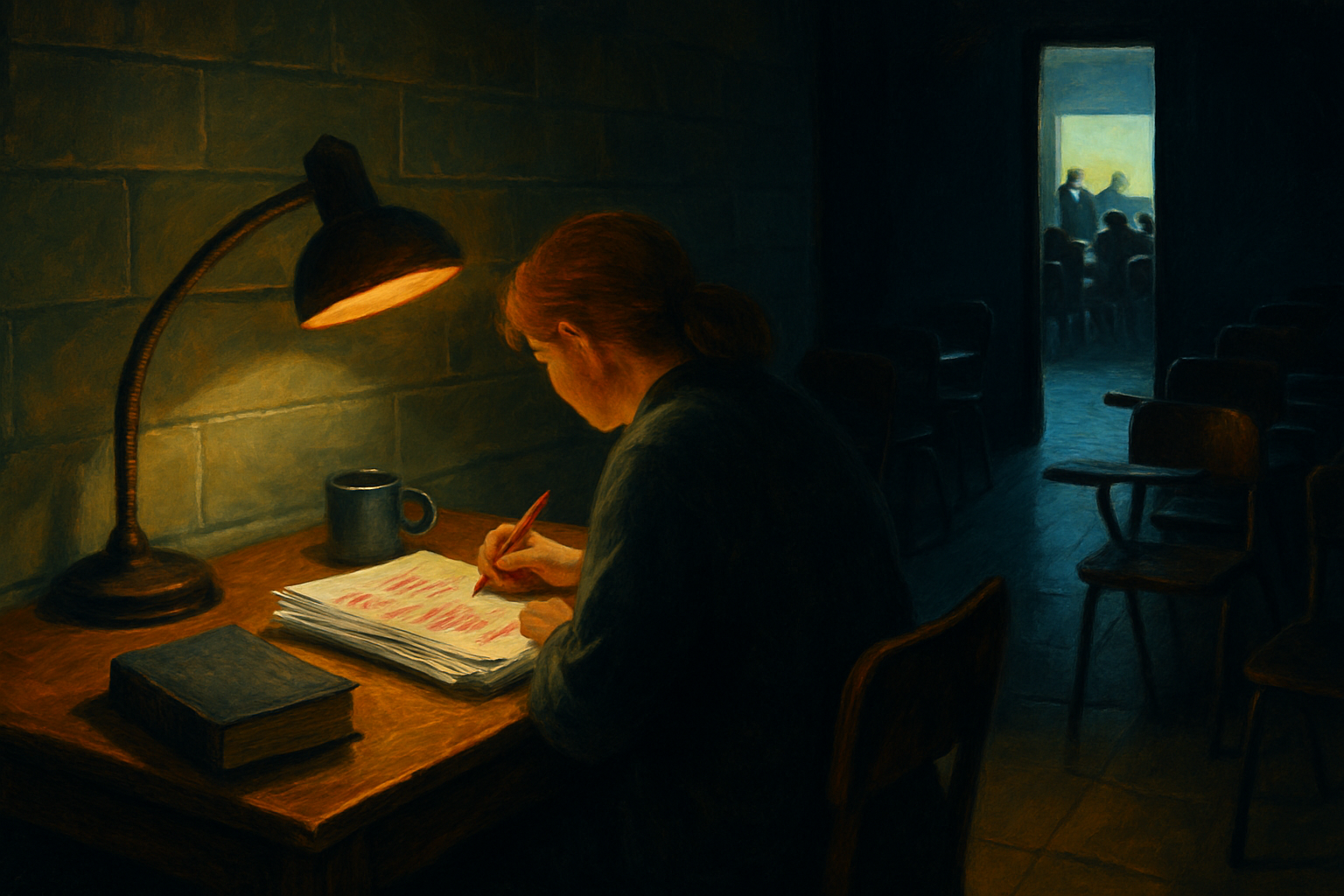
Exercise 8 of the Playing With Purpose series
The Exercise
Find a comfortable position where you won’t be interrupted for twenty minutes. Set an alarm so you don’t have to think about time. Then do this: breathe slowly and deliberately, and with each exhale, let one thing go. Not solve it. Not process it. Just set it down temporarily. Your to-do list. The thing you said this morning that didn’t land right. The project that’s behind schedule. Breathe out and set it down.
Do this for five minutes and see where you land.
Then answer these:
The reflection questions:
- Were you able to let things go even temporarily, or did your mind fight the exercise?
- What was the quality of the mental state you reached, even briefly?
- Do you have a practice, any practice, that reliably gets you to a quiet internal space?
- What has come to you in those quiet spaces that wouldn’t have come in the noise?
- What would it mean to treat that state as something buildable, not something you wait for?
What I Learned When I Did This
I read an article in Psychology Today when I was in high school about athletes using self-hypnosis as a training method. I was already fascinated with how the brain works, always had been, and something about the idea that you could deliberately enter a different cognitive state and use it intentionally was immediately interesting to me. So I tried it. And I got somewhere.
I want to be careful here because I’m not making any grand claims about what self-hypnosis is or isn’t. What I know from my own experience is that there are states of awareness that are qualitatively different from ordinary waking consciousness, where the noise drops, the linear processing slows down, and something else becomes available. I learned to find that state in my late teens and I’ve been using it ever since.
At military school, where the boys lived together in a boarding environment and a free afternoon meant you had to entertain yourself, I practiced on classmates. Walked them into states of deep relaxation, possibly light hypnosis. Something to do. No harm intended and none done. At nineteen, sitting alone on a Florida beach with no one around and nowhere to be, I pushed further than I’d gone before. I’d read about people controlling nerve endings, about the body’s capacity to modulate pain and sensation when the mind is in the right state. I decided to find out how far I could actually take it. I put a lit cigarette out on the back of my hand. It didn’t turn red.
I now understand, in a way I didn’t at nineteen, how something like that is possible. I understand it doesn’t make me special. It’s a demonstration of what’s available to most people who learn to work with their own nervous system rather than just responding to it. But at the time it was genuinely shocking, and it fundamentally changed how seriously I took the practice.
The practical version I’ve used for decades: during my first sales job I drove 60,000 to 70,000 miles a year around Florida. Some days I’d finish at eight in the evening needing to be fresh and sharp two hundred miles away at eight the next morning. I learned to pull into a rest stop, put myself into a deep relaxed state, program my internal clock for exactly twenty minutes, and wake up refreshed. I still do this. My wife finds it unsettling because I’ll say I’m taking a twenty-two-minute nap, appear to be asleep within thirty seconds, and come back twenty-two minutes later fully present. I’m not sure I’d want to explain this to someone who’s never experienced it from the inside, but the mechanism is real and learnable.
The newest dimension of this is the treadmill. I discovered a few years ago that I can reach something close to the same state during a workout, twenty to thirty minutes in, with music and movement and the right rhythm, where time stops and the mind clears in a specific way. I focus on a point between my eyebrows, start as a dot of light and try to expand it, and somewhere in that process I cross into a space where insights surface that weren’t available before the walk. I use that space for intentional work now: forgiveness, releasing things I’ve been carrying, processing experiences I haven’t fully digested. After those sessions, ideas and connections I’d been circling for weeks will just be there, clearly, as if they were always obvious.
The exercise I’d put in front of anyone reading this isn’t “learn self-hypnosis.” It’s simpler than that. It’s: find one reliable practice that gets you to a quieter state than ordinary waking consciousness, and treat that state as a resource rather than an accident. Most of us have accidentally accessed it. The question is whether you’ve learned to build it on purpose.
Playing With Purpose is a series of creativity exercises for people who want to understand and reclaim their creative capacity. You don’t need to be an artist. You need to be curious.
For Further Reading
Explore these resources for deeper context on the ideas in this post.
- Redefine Your Design Skills to Prepare for AI (NN/g) — Principles over tool dependency
- Machine Learning Has Already Transformed Design (AIGA) — Ethics of tool dependency in design