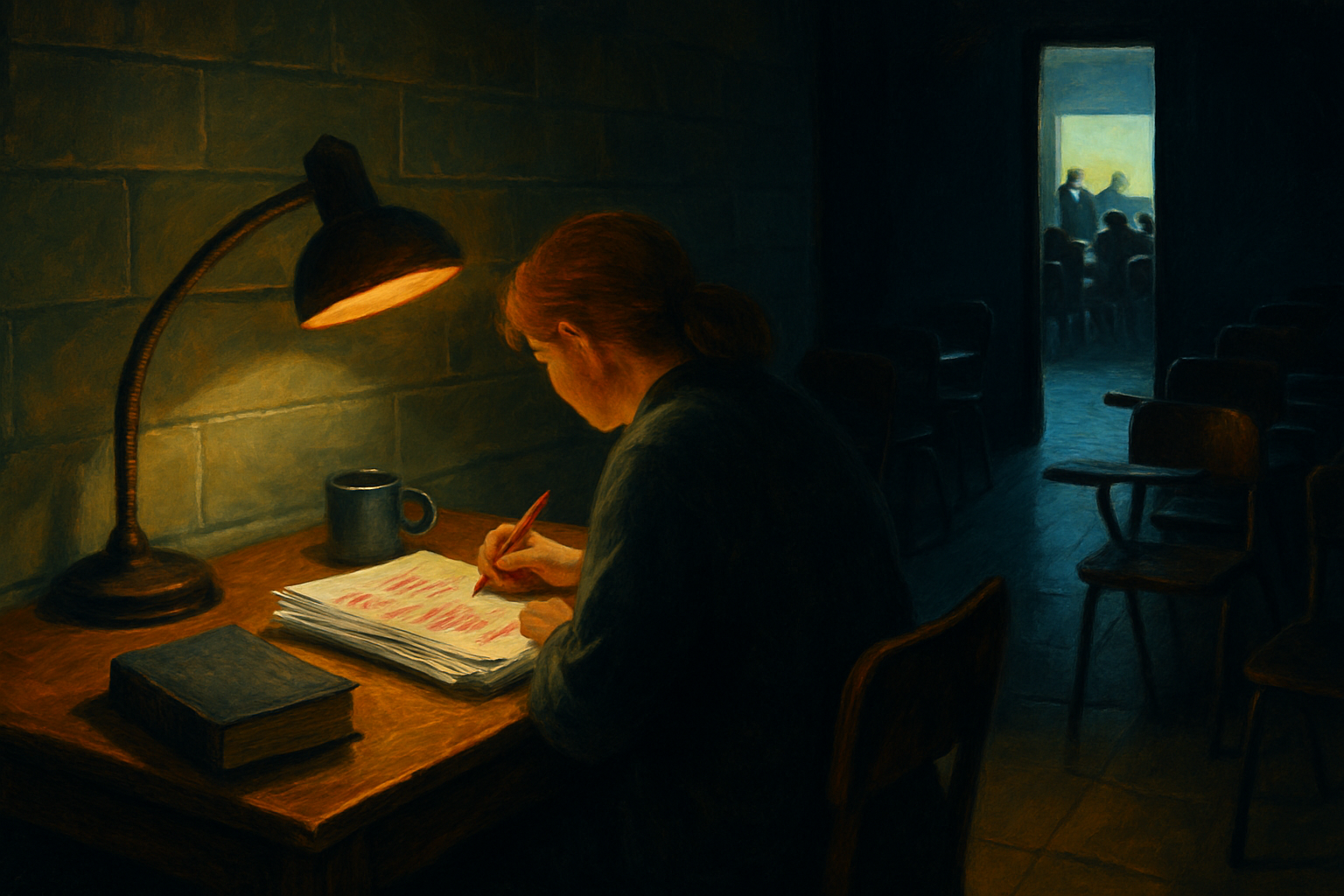
I was doodling through most of my classes in high school, and every teacher in the room saw the same thing: a kid who wasn’t paying attention. What they didn’t see was that the doodling was the mechanism I needed to pay attention. The pen moving, the image forming on the page, that was what let me hold the thread of what the teacher was saying. The moment I put the pen down, the information scattered. The moment I tried to sit with my hands still and my eyes forward and my notebook blank, everything the teacher said went sideways through my brain and out the other side without landing anywhere. But hands moving, image happening, words entering simultaneously, that worked. That worked perfectly. Teachers saw a distraction. My brain was processing in the way it knew how.
This continued through every phase of education. I could repeat back what a teacher had just said with accuracy if they asked me five minutes later. But if they asked me to argue the point or defend a thesis right there in the moment, I’d lose the thread. I couldn’t think in real-time. I had to process it first, write it down, let it sit, come back to it. Linear discussion happened too fast. My brain needed the mediation of hand and paper and time. It looked like I wasn’t keeping up. It felt like I wasn’t keeping up. For years, I believed I wasn’t keeping up. The real story was just different: I was processing in a way that didn’t match the pace of the classroom.
I was diagnosed bipolar mid-twenties, and that changed how I understood myself. Not because I suddenly had a label that explained everything, but because the label let me stop blaming myself for things that were actually just how my brain was built. There were times when I had ideas in a flood, when my mind would move at a speed that was just outside the range of useful; there were times when the world felt heavy and gray and I couldn’t generate the energy to move through it. Neither state was a moral failure. Neither state was something I could think my way out of. But the first state, the one where ideas came fast and loose and weird and sometimes genuinely good, that state had always felt like something I should apologize for. Turns out it was connected to the same thing that made the slow-thinking possible.
I managed it all without medication, which is not advice for anyone else but is the thing that worked for me. Physical activity became the primary regulation tool. I started running, and that’s where the processing happened. That’s where the mind could move at whatever speed it needed to move at without needing to keep pace with anything external. A thirty-minute run at dawn is like hitting a reset button on the whole system. The treadmill is a place where you can let your mind work the way it works without trying to force it into someone else’s schedule. I’ve been doing that for decades now, and it’s the most important thing I’ve ever done for my own stability. Not because it fixed anything; because it gave the broken thing permission to be what it was.
The creativity connection took me longer to understand. The same brain that couldn’t sit in a chair and follow a linear sequence of explanation was generating ideas at three in the morning that were actually worth writing down. The same processing style that made real-time discussion impossible let me see connections that other people weren’t seeing. Different is not the same thing as broken. I spent years thinking it was broken. I spent years trying to fix it. The truth is that it was just different, and different can be a liability in the wrong environment and an asset in the right one. The trick is understanding the difference. The trick is not trying to force a different kind of brain into the shape it was never supposed to fit.
Teaching gave me the vocabulary to understand what I was seeing in other students. I learned to recognize the ones whose brains worked differently, the ones who were doodling in the corner and actually processing better than the ones with their hands folded on their desks. I learned to look for the ones who couldn’t think in real-time but could write you something brilliant if you gave them thirty minutes. I learned to stop mistaking the method for the effort. What looks like distraction might be focus. What looks like slowness might be depth. What looks like a deficit might just be a different operating system, and the goal isn’t to fix it. The goal is to understand what it needs to work, and then let it work that way.
The creativity exercises I built over decades were built from that understanding. Not from the idea that everyone’s brain works the same way and some people just need to try harder. But from the idea that there are many different kinds of minds in a room, and the exercises need to let each one of them work. The ones who think fast, the ones who think slow, the ones who need movement, the ones who need quiet, the ones who think in words and the ones who think in images. None of it is a bug. None of it is a deviation. It’s just the actual human variation, and the system that pretends there’s only one right way to think is the one that’s broken, not the brain.
Further Reading
- How to Design for Neurodiversity (IxDF) — Designing inclusively for neurodivergent users
- I’m a Creative Director with Dyslexia, AI Takes My Creativity Further (PRINT Magazine) — Neurodiversity in creative professions
- People with ADHD may be more creative (Fast Company) — Research linking ADHD to creativity