The retention pond on my property dried up completely during the drought. It’s usually a few acres of water, shallow enough that herons wade through it, deep enough that it matters in a heavy rain. But that particular summer it just evaporated, and by August the floor was exposed and cracked, bare ground in what should have been water. I watched the moisture retreat week by week, wondering when it would finally break, when the rains would come back.
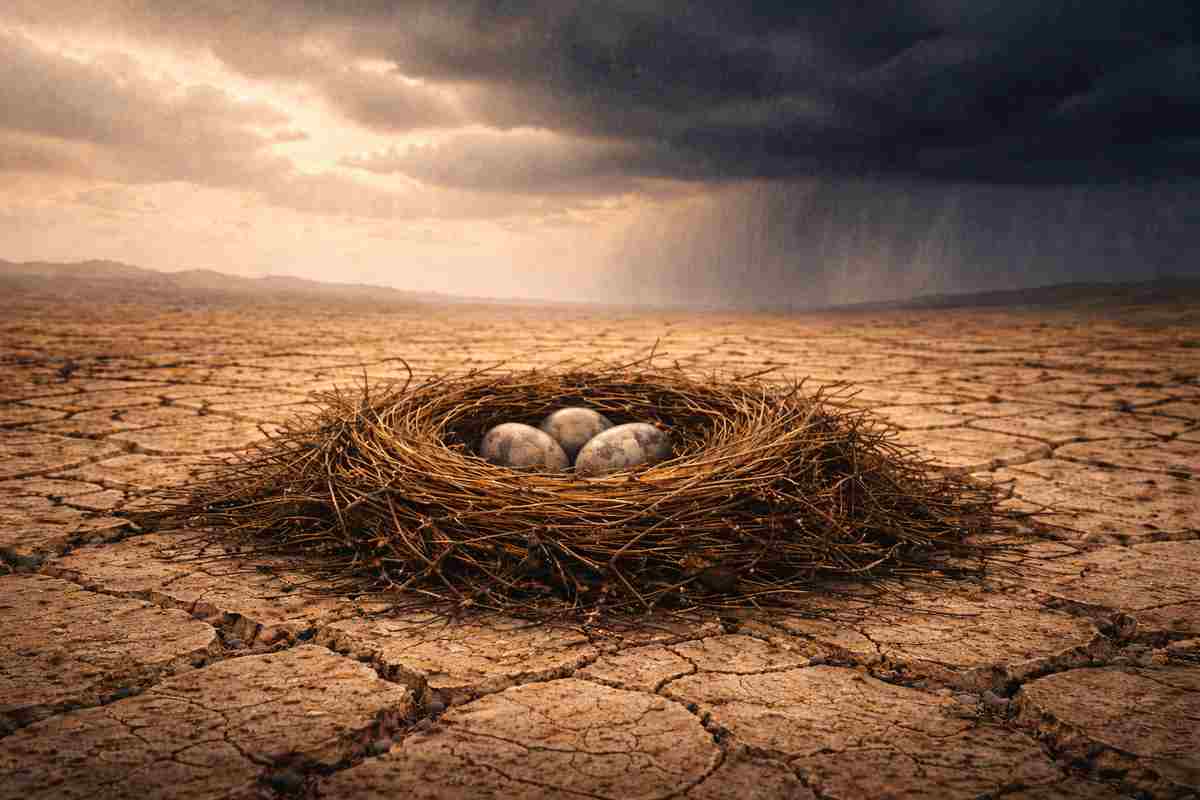
That’s when the sandhill cranes arrived. A pair of them showed up and looked at this bare, exposed pond floor and decided it was the perfect place to nest. I watched them in the mornings, moving around the center of the dry pond, preparing the spot. They built their nest right in the middle of where the deepest water should have been. Protected by nothing. Protected by water that wasn’t there.
The instinct made perfect sense. In normal times, a nest in the center of a pond is protected. Predators can’t reach it. The water keeps everything at distance. I understood the logic. But the timing looked catastrophic to me. They were nesting at the exact moment when the system that was supposed to protect them had failed. The next hard rain would come, and that exposed floor would become water again, and I couldn’t imagine how eggs in a nest at ground level would survive that. I checked on them regularly, sometimes from a distance, trying not to intrude. They were committed to it, though. They incubated the eggs through September. Through the heat. Through the waiting.
Then the rains came, harder than expected. That pond filled up fast. The water was rising, and I thought about that nest in the center of it, and I assumed the worst. The timing that had looked so fragile, so miscalculated, had become a disaster. I didn’t check on them for a while. I couldn’t bear to look.
Then one morning I was at the edge of the pond, and I saw them. Both cranes, and with them, one chick. A single baby, alive and being fed, moving through the water with its parents around it. The parents had gotten it right. The nest was in water now, and the chick was in the water with them, exactly where a crane chick is supposed to be. The instinct that had looked wrong, the timing that had seemed catastrophic, had been exactly right. They had nested at the moment of maximum vulnerability because they understood something I didn’t. They knew the rains would come. They knew the timing. They moved by instinct through a calculation I couldn’t see, and it worked.
I watched the chick being fed, being guided through the shallow water by its parents, and something in that moment settled something in me. Not a lesson, exactly. Not a moral I could extract and apply to my life. Just a recognition that there are creatures who move through the world without overthinking the timing, without second-guessing the instinct, and they get it right. The vulnerability is not a mistake. The exposure is part of the calculation. The moment that looks like it shouldn’t work is the moment when everything is about to work perfectly, if you trust the rhythm and don’t let fear rewrite your instinct.
The chick stayed in that pond through the fall, grew through the season, and then they left together, the three of them, when the time came. I don’t know where they went. But I’ll remember that one morning when I thought I’d lost them and then found them exactly where they were supposed to be, thriving in the water that had returned, protected not by absence but by presence, by the rain that had finally come.
For Further Reading
Explore these resources for deeper context on the ideas in this post.
- Good Visual Design, Explained (NN/g) — Learning to see and observe the world
- What is Visual Perception? (IxDF) — How we perceive and process visual information