Exercise 1 of 20 from the Playing With Purpose Student Edition
From Book 1: The Door (Exercises in Permission)
The Parable
Marcus wanted to write a children’s book. He sat for three weeks with a blank page. The fear was simple: anything he wrote would be terrible. So he wrote nothing. One afternoon, frustrated and tired, he decided to write the worst possible children’s book ever written. A story that made no sense. Characters with names like ‘Blob’ and ‘Green.’ A plot that went nowhere. He wrote it badly on purpose. He made it hilariously awful. He showed his wife what he had written. She laughed so hard she cried. Inside the worst possible version was a line that made her laugh again: ‘What if the door was a character too?’
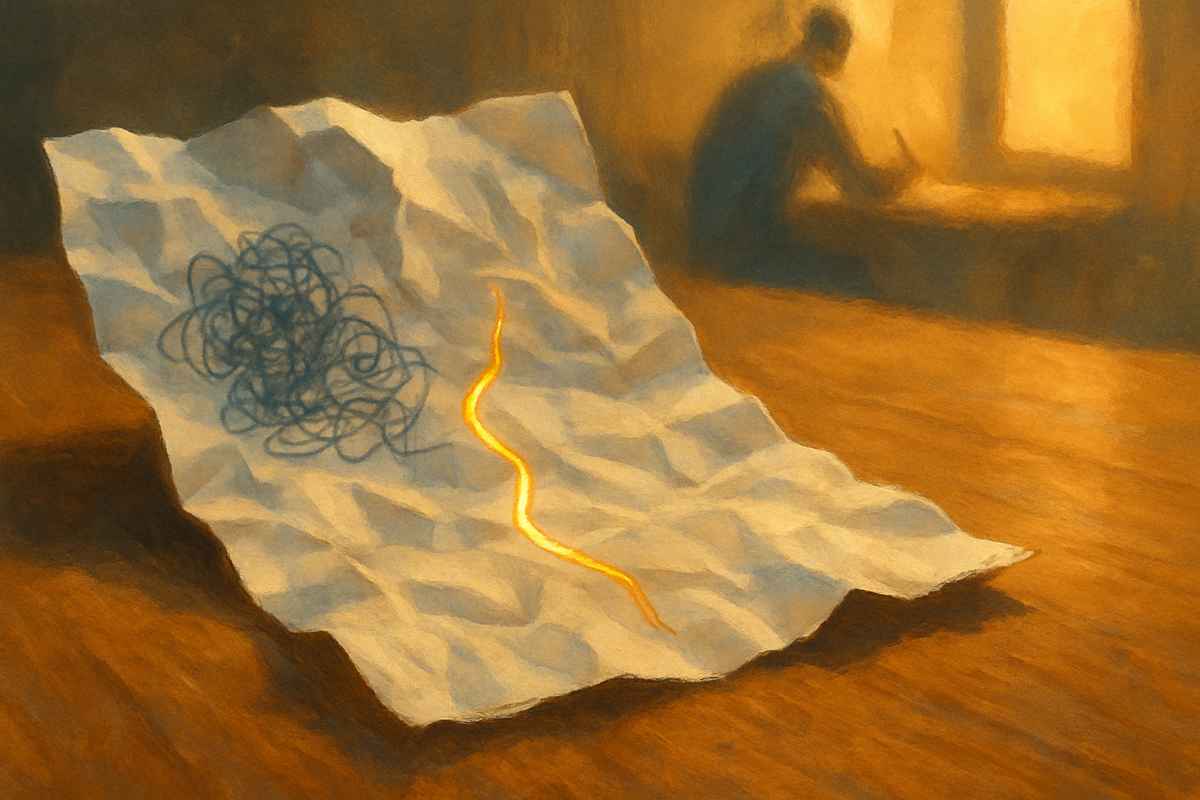
That line became the heart of his actual book. But it only existed because he had given himself permission to write terribly. The blank page had been terrifying. The worst possible version was joyful. Fear lives in the abstract. Awfulness is concrete. Once something is on the page, even something intentionally dreadful, you can work with it. You can change it. You can find the one thing inside it that actually sparkles.
The Exercise
Pick something you want to make. Anything. A song. A story. A design. A business idea. Then make the worst possible version of it on purpose. Write it badly. Make it intentionally terrible. Include characters with ridiculous names. Make the plot make no sense. Include colors that clash viciously. Make it hilariously, deliberately, gloriously awful. Your job is not to make something good. Your job is to make something so bad it becomes entertaining.
When you finish, read it. Look for the one thing inside the mess that actually works. One image. One phrase. One moment. Mark it. That moment is often the beginning of the real thing.
Reflection Questions
1. What was easier about writing the worst version than writing a good version?
2. What surprised you about what you created?
3. Which part of the worst version might actually belong in a real version?
4. What would happen if you made a second awful version after this one?
What We Were Trying to Do
Your fear is not about making something bad. Your fear is about making something you care about that turns out bad. The worst possible version removes that fear because you are already aiming for bad. You have given yourself permission to fail completely. Once failure is the goal, the page stops being terrifying.
Why It Matters
You believe the first version should be good. Not perfect, but good. Competent. Worthwhile. This belief is paralyzing because the first version is almost never good. It is almost always messy, confused, unclear, and full of false starts. So you don’t start. The blank page represents the failure you are trying to avoid, so you avoid the page itself.
Here is what actually happens when you aim for the worst version. You write fast. You don’t edit yourself. You don’t second-guess. You don’t wait for inspiration. Your hand moves because you are not trying to be good. You are trying to be bad. Bad is available right now. Bad does not require inspiration. Bad does not require confidence. Bad only requires surrender.
The research shows something strange. When you deliberately lower the bar, you often clear it higher. The act of moving forward, of making marks, of creating something concrete, activates the part of your brain that can actually improve things. You cannot improve a blank page. You can improve something awful. You can take something hilariously bad and find the one moment inside it that matters. That moment only exists because you wrote the worst version first.
References & Further Reading
James Clear’s research on the importance of the first attempt (Atomic Habits, Avery, 2018, chapters 2-3) demonstrates that imperfect action beats perfect planning. Mihaly Csikszentmihalyi’s flow research (Flow: The Psychology of Optimal Experience, Harper Perennial, 1990) shows that engagement happens when challenge exceeds fear, which occurs when you remove performance pressure. Shel Silverstein and Roald Dahl both deliberately broke children’s literature rules by allowing ugliness and strangeness into their work, creating space for imagination. Research on psychological safety by Amy Edmondson (The Fearless Organization, Wiley, 2018) shows that permission to fail productively increases actual achievement.
Going Further
You might make five worst versions. The second one is often worse than the first, which means it is more liberating. By the third or fourth terrible version, you stop thinking about the outcome and start playing. Play is where actual creativity lives.
You might share your worst version with someone. Tell them it is supposed to be terrible. That person will often find the one thing that works and point it out to you. You might not have seen it yourself because you were too busy being awful.
This exercise works because it removes the thing that actually stops you: the hope that what you make might be good. Once you have written permission to be bad, your hand moves. The page fills. The thing becomes real. And somewhere inside the awfulness is something that might actually be worth keeping.
This exercise is from the Playing With Purpose Student Edition by Greg Williams. The complete series of 650 exercises across 10 books is planned for publication in summer 2026.
This is practice. Nobody will grade this.