—
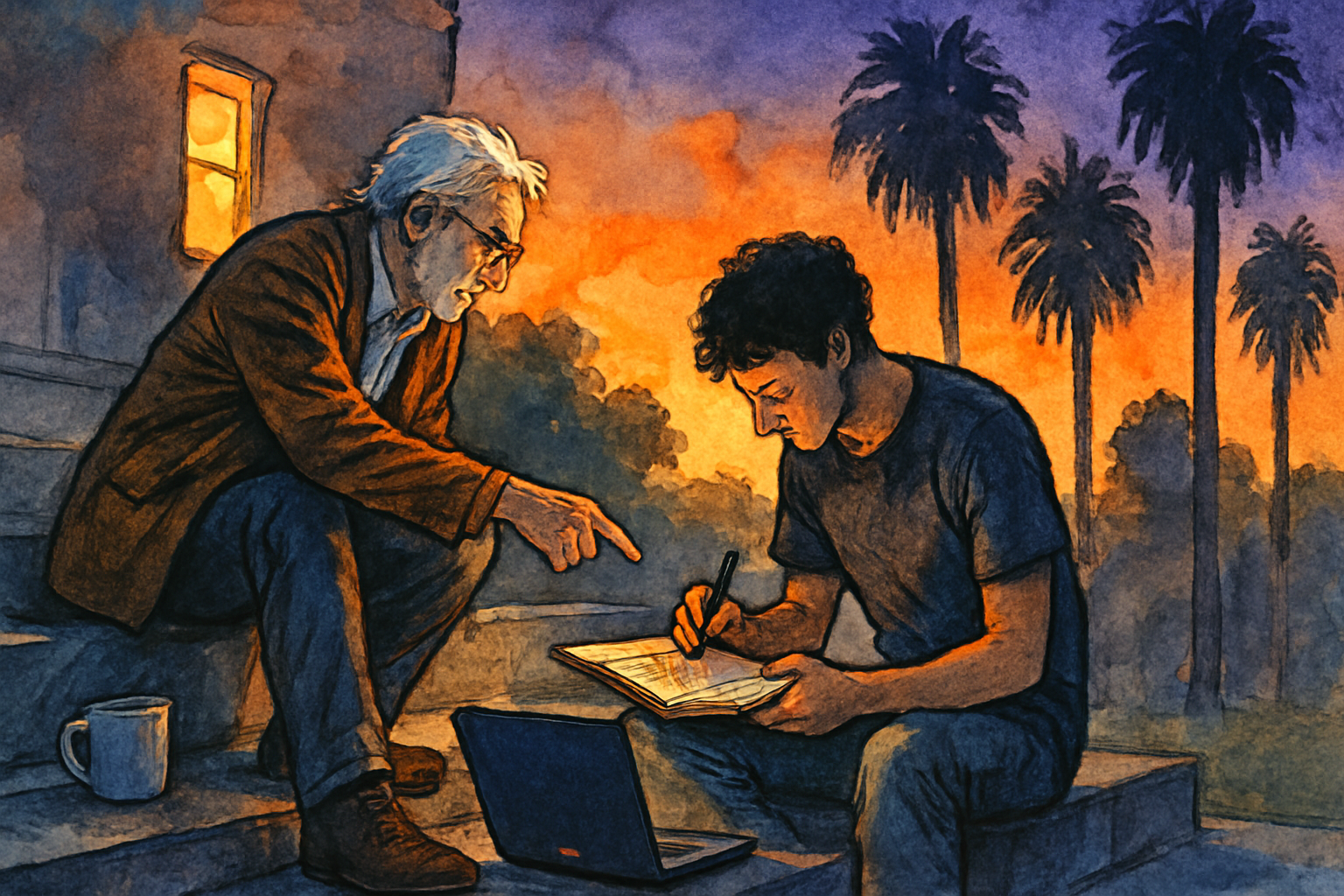
I was teaching a student Photoshop one afternoon, and I wasn’t really teaching, not in the way I’d planned anyway, I was just following what the image needed next. Select this layer. Now put some light behind it. Maybe it should be in a window. And if it’s a window, it should probably be in a wall, so let’s build the wall. And if there’s a wall, there might be spray paint on it, faded and broken up, dripping down the brick, because that’s what walls like that look like. We went on like that for an hour and a half, and I honestly couldn’t tell you at any point where we were going, because we weren’t going anywhere, we were just following the next true thing. The final piece was extraordinary. My wife Terri saw it and said, “I want that for my office.” And I said yes, and then she asked if I could make more, and I had to tell her no, not because I was being difficult, but because I genuinely do not know how I got there. Every time I’ve tried to plan a version of it, to replicate the sequence intentionally, it feels forced, it feels like a copy of a copy, and it dies on the screen. The original wasn’t made. It grew.
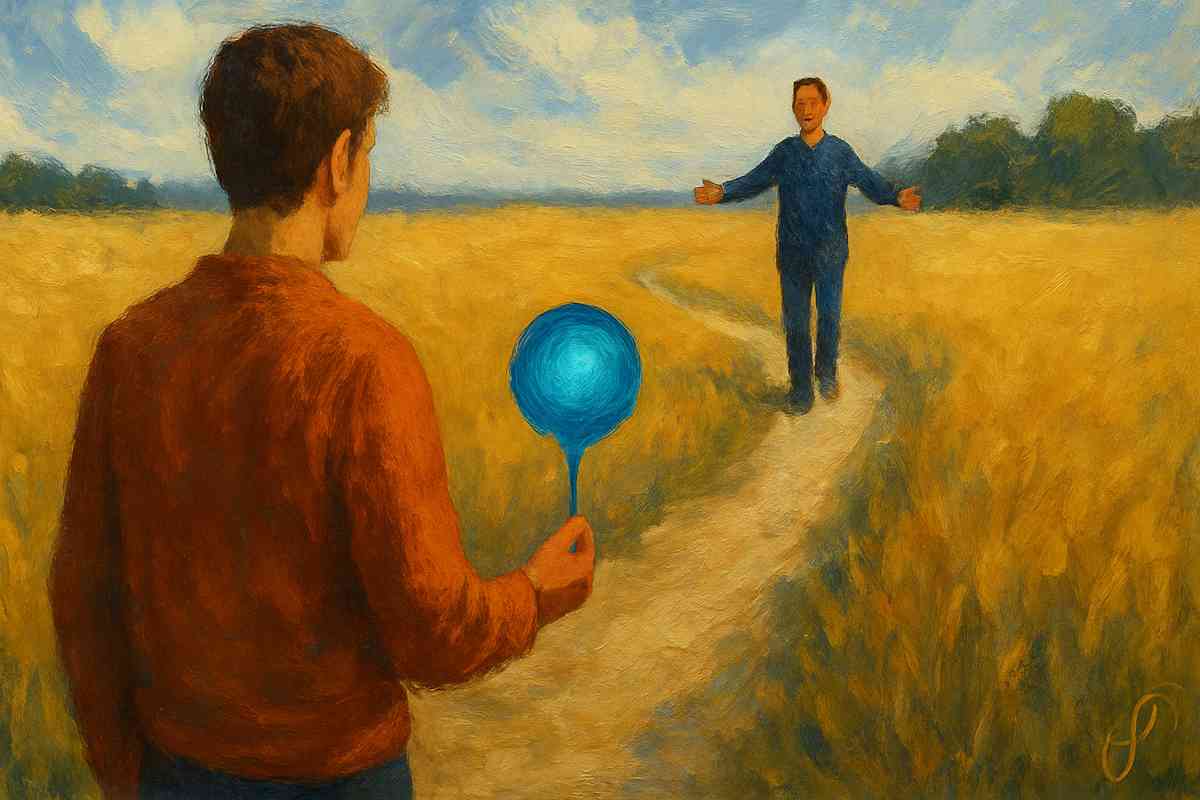
I’ve thought about that afternoon a lot since then, because it showed me something I didn’t have language for at the time. What happened in that session was Generate without Judge. I was generating freely, following each decision into the next one, and the judging part of my brain, the part that says “this won’t work” or “this isn’t good enough” or “where is this even going,” that part was quiet. Not gone, just quiet. And because it was quiet, something got to exist that couldn’t have survived the scrutiny of a plan.
Here’s the thing that took me embarrassingly long to understand: creative work has a sequence, and that sequence can be broken, and when it breaks, you get the blank screen. You get the student sitting there looking at an empty document at 2am with nothing. You get the designer who can’t start a project until they know where it’s going. You get me, every time I’ve tried to make another version of that poster.
The sequence goes like this: Generate, then Observe, then find Meaning, then Judge. Four phases, each one distinct, each one dependent on the one before it. Generate means you make stuff, you throw things at the wall, you follow the next true thing without asking whether it’s the right thing. Observe means you look at what you actually made, not what you intended to make, you notice where the surprise is, where the work went somewhere you didn’t plan. Meaning is where you ask what that surprise is telling you, what the gap between your intent and your result is actually about. And Judge, finally, is where you evaluate it, where you bring your taste and your standards and your critical intelligence to bear on something that already exists and can defend itself. That order matters more than almost anything else I’ve learned about creative work.
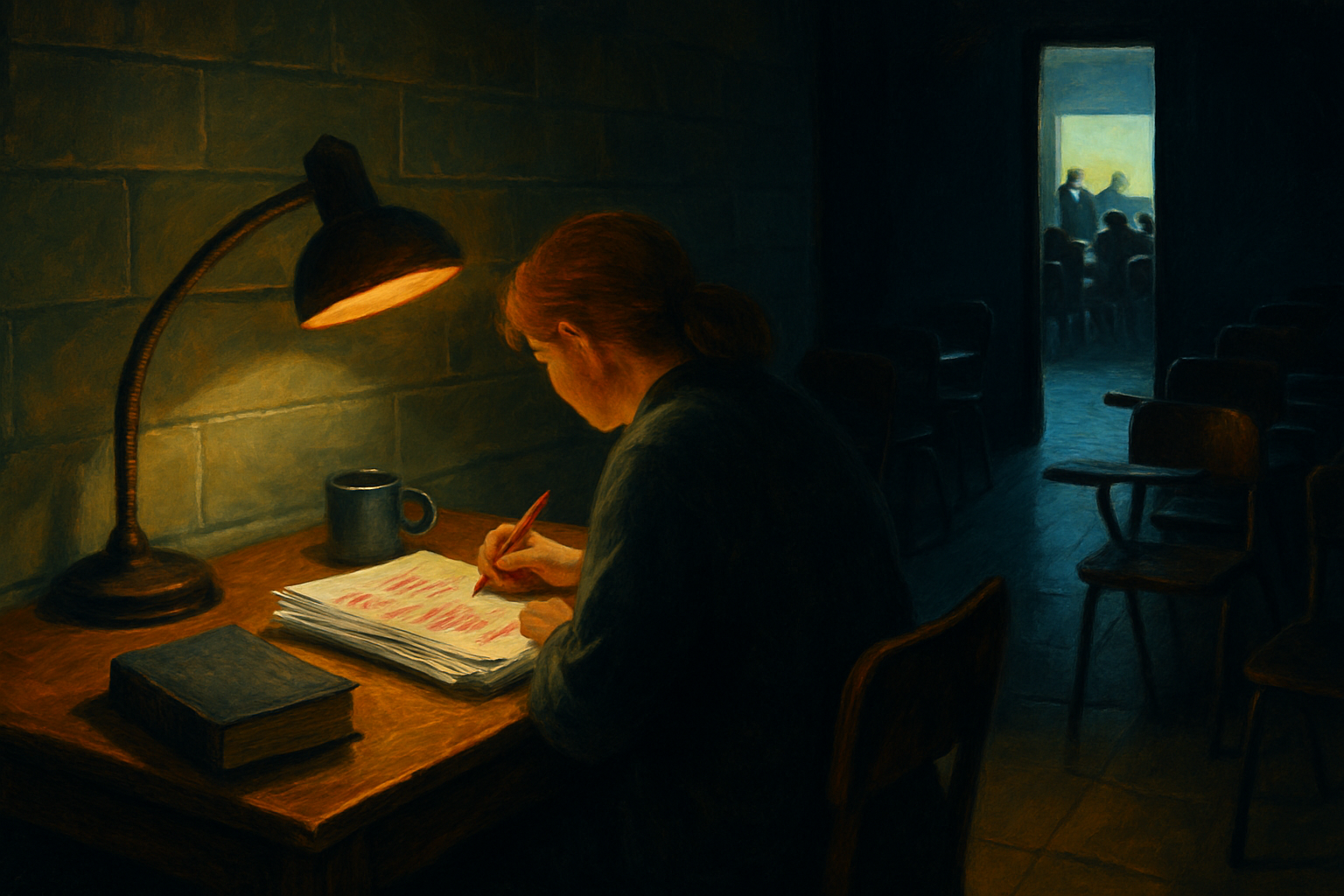
The problem, and I mean the actual problem, the one I see every semester in every class, is that most people collapse Generate and Judge into a single step. They are making and evaluating simultaneously, which means they are editing before they’ve even started, which means the fragile new thing never gets a chance to exist before the critical machinery tears it apart. You know what that sounds like from the inside? It sounds like “I don’t know where to start.” It sounds like “I don’t have any good ideas.” It sounds like “I’m just not that creative.” It is none of those things. It is a sequence problem.
I figured this out, or started to figure it out, around Christmas 2019, and I’ll be honest with you, it was a little humbling. For twenty-five years I’d been watching this pattern repeat. One or two students per class who overflowed with ideas, who started three projects before the rest of the class had named one, who seemed to generate almost effortlessly, and then the rest of the room sitting there frozen, looking at the person next to them like maybe creativity was something you either had or you didn’t. I’d tried everything I knew to fix it. Better prompts. More time. Smaller constraints. Different constraints. And then I found Stefan Mumaw’s work on creativity as a teachable skill, and something clicked that had been rattling around loose for years. Creativity isn’t a trait. It’s a practice, and more specifically, it’s a sequence, and students were failing not because they lacked the capacity but because they were doing the steps out of order.
So I started doing five or ten minutes of structured creativity exercises at the start of every class. Pure play. No grade, no product, nothing to turn in, nothing to evaluate. Just generate. Within three weeks, and I’m talking less than an hour of total classroom time across those three weeks, the room changed. Students were making lists of possibilities before jumping to solutions. They were building on each other’s ideas instead of protecting their own. The quality of the work deepened in a way that was visible, that I could see in the room before I even looked at what they’d made. I remember standing there thinking, where has this been my entire career. Those exercises eventually became 650 of them, a full series, but the insight that started it was simple: the exercises separated Generate from Judge, and once those phases had room to breathe independently, the work that came after them was different.
What I want you to understand, and this is the thing I keep coming back to, is that most creativity problems are actually diagnosis problems. Something in the sequence is breaking, and if you don’t know the sequence, you can’t find where it’s broken. If you collapse Generate and Judge, your ideas die before they’re born, and you call it a creativity problem. If you skip Observe, if you go straight from generating to assigning meaning without actually looking at what you made, you end up with work that means what you planned for it to mean instead of what it actually means, and there’s a significant difference between those two things. If you skip Meaning entirely and go straight to judging, you get technically competent work that nobody cares about, work that passes every quality check and leaves everyone cold.
The Hope poster, the one that grew for an hour and a half and turned into something Terri wanted on her wall, that happened because the sequence ran correctly. Generate ran first, ran long, ran without interruption. Observe happened naturally as I looked at what was accumulating on screen and followed where it led. Meaning surfaced on its own by the end, I didn’t assign it, it was just there. And Judge arrived last, quietly, in the form of “yes, this is done, this is what it is.” I didn’t plan any of that. But I can see it now, in retrospect, and seeing it means I can protect it, I can give it room, I can recognize when I’m collapsing phases and stop.
You can learn to do the same thing. Not by memorizing a framework and applying it like a formula, but by noticing, the next time you’re stuck, which phase you’re in and which phase you’re actually running. If you can’t start, you’re probably judging before you’ve generated. If you’ve made a lot but don’t know what it means, you skipped Observe. If the work feels competent but hollow, you probably skipped Meaning. The blank screen is not evidence that you’re uncreative. It’s a symptom, and symptoms have locations, and locations can be found.
Start ugly. Start without knowing where you’re going. Follow the next true thing. The sequence will do the rest.
Keep Reading
- The First Answer Is Always Slop
- My Musical Taste Stopped Evolving in 1983 (and That Turned Into a Research Question)
- Stories Don’t Explain a Principle — They Install It
- What If a Song Wrote Your Next Design?
Go deeper: What Creativity Actually Is · All Primers