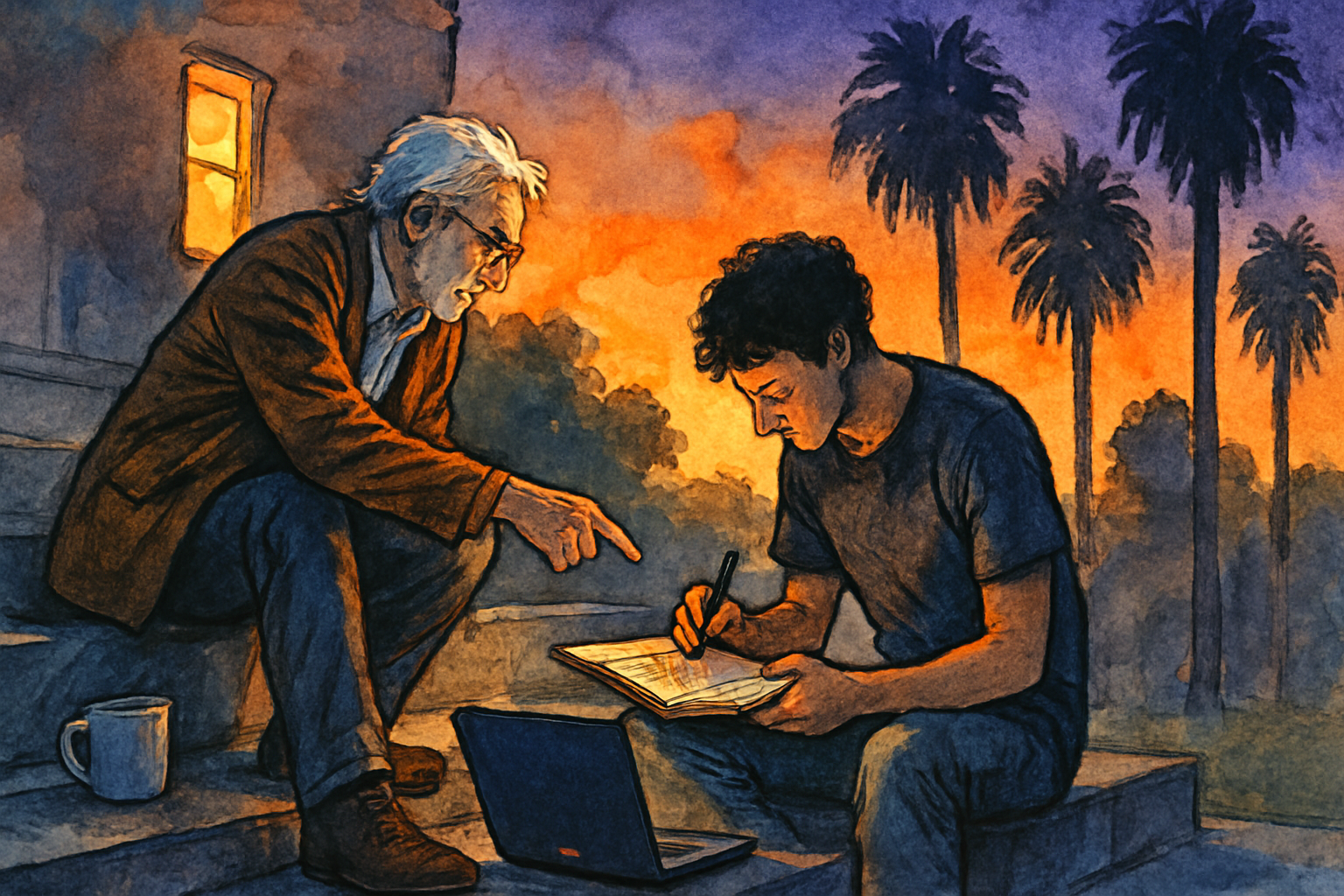
Hargrave Military Academy. I arrived with a 1.2 GPA and an attitude that suggested I was doing you a favor by showing up at all. I was angry. I was convinced that I was smarter than my grades suggested, which is something almost every struggling student thinks, and sometimes it’s true and sometimes it’s not. In my case, I was wrong about being smarter, but I was right about something: the system I’d been in before was not built for how I actually worked. At Hargrave, something different happened. The classes were small enough that your teachers knew you not as a GPA or a record or a category. They knew you as a person who was in the room.
Mr. Burke. Coach Klein. Mr. Ramsey. Reverend Cohen. These names mean something specific to me because they were the first adults I’d encountered in an educational setting who treated teaching like it was a different job than I’d thought. They came to dinner in the dining hall and sat with students. They walked the dorms at night not to catch people breaking rules but to check in. They had conversations that didn’t have to lead anywhere. They noticed things. They paid attention. I was a kid who had learned to interpret inattention as a judgment about his worth; at Hargrave, these teachers communicated something different, which was: I’m watching because you matter, not because I’m waiting for you to fail.
The specific moment where this mattered most was the battalion commander fight. I was elected, which in a military school means something about how your peers see you, but it also means you’re a target for a certain kind of institutional pressure. The system turned on me. There were politics that you learn much later are more complicated than they seemed at the time, but in the moment it felt like: I did the right thing and now I’m being punished for it. I was going to quit. I was angry enough to walk away from the whole thing and tell the whole school exactly what I thought. I was seventeen years old and righteousness felt like a reasonable strategy.
These four men, these teachers, showed up in small ways that accumulated into something like salvation. They warned me about inspections I didn’t know were coming. They rallied behind me in conversations I wasn’t in. They modeled something about what loyalty looks like when someone else is under siege. They showed me that there were adults who were willing to stand beside a student not because that student was easy to stand beside, but because they had decided that the student was worth standing beside. That’s a different kind of teaching than content delivery. That’s not a grade you can calculate. That’s character transmission. That’s one human refusing to look away from another human when looking away is simpler.
I think about those years a lot now, forty-plus years later, when I’m in my own classroom with my own students, and I realize that’s what I’ve been trying to do the whole time. That’s the model I’m working from. The critique I give is scaffolded by where the student actually is, not by some abstract standard of excellence. The feedback is designed to build them up, not to break them down. I remember every conversation with those four men, and in every one of them, the subtext was: I see you. I’m not reducing you to your record. I’m not looking away. I’m refusing to let the system make you less than you are.
The thing that Mr. Burke and Coach Klein and Mr. Ramsey and Reverend Cohen did for me is that they showed me what a teacher is actually for. Not to dispense information or to grade performance or to rank students against each other. Those things happen, but they’re not what teaching is for. Teaching is for seeing someone and refusing to reduce them to their category. It’s for standing beside them when the world is set up to push them down. It’s for communicating, through attention and presence and small consistent loyalty, that they matter. That their effort matters. That their growth matters. That they’re not just a number on a roster but a human being who is trying to figure out how to be a human being in a complicated world.
Every student I’ve ever taught has walked into my classroom with a story about a teacher who didn’t see them, a system that measured them wrong, a moment where they were reduced to a mistake or a category or a number. My job is to be the teacher who sees them differently. To be like Mr. Burke, like Coach Klein, like Mr. Ramsey, like Reverend Cohen. Not because I’m special, but because I remember what it felt like to be seen that way, and I remember what happens when someone does that for you. It changes who you become. Not because of what they taught you, but because they refused to reduce you to your record, and you learned something from that about how to be human that no curriculum could have delivered.
For Further Reading
Explore these resources for deeper context on the ideas in this post.
- UX Mindsets: Fixed Versus Growth (NN/g) — Growth mindset and learning from failure
- Getting into the Discovery Mindset (NN/g) — Learning through failure and challenging assumptions