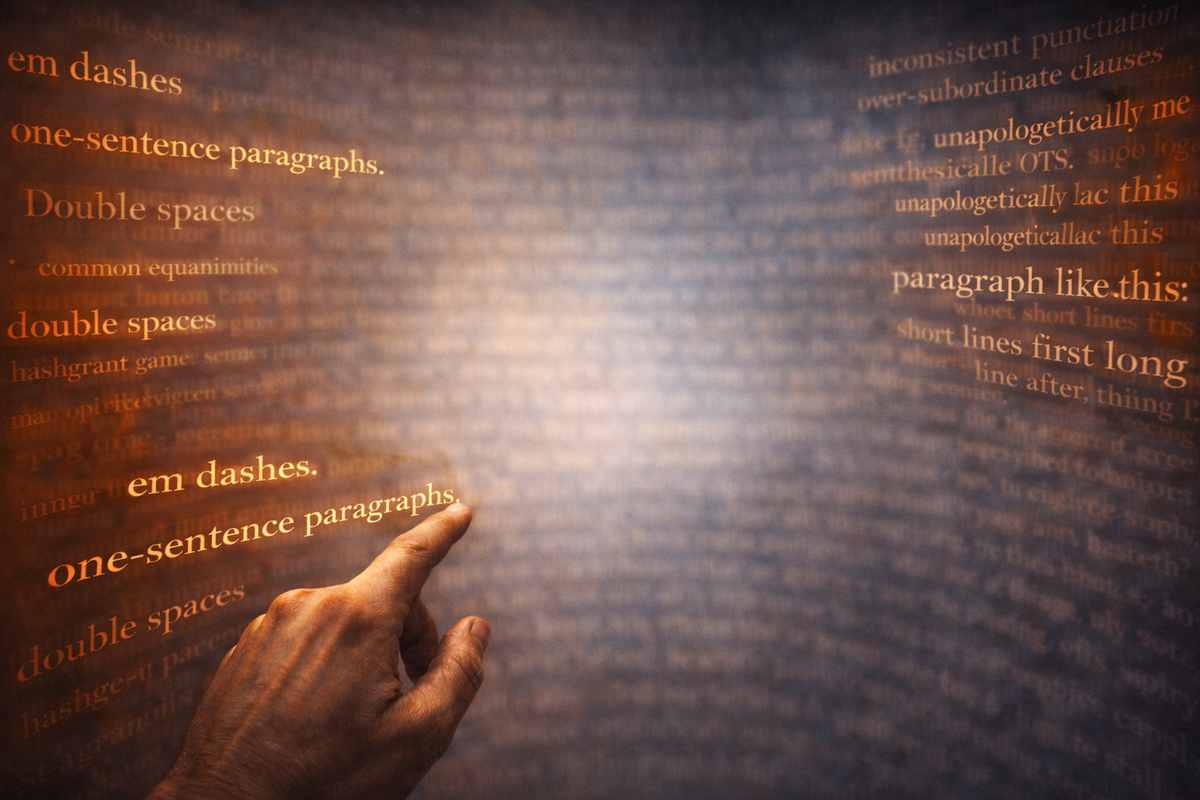
I’ve been building these blog posts with AI for years now, and at first it was fine. I’d give it a structure, a story, some direction, and it would come back with something solid that I could edit and publish. The collaboration worked. But then I started noticing patterns. After I’d explicitly said no one-sentence paragraphs, they’d start appearing again. Em dashes would show up post after post, which I’ve never used in my entire life. The formatting would shift toward what I think of as scan-friendly, the kind of thing where you break ideas into bullet points and callouts because the reader supposedly doesn’t have the attention to follow a paragraph anymore. And the language, even when the facts were correct, had a particular warmth to it that sounded like nobody in particular. Generic, careful, optimized for some invisible audience that I was never writing for anyway.
At first I thought I was going crazy. Had I actually said no to one-sentence paragraphs? Let me check my notes. Yes. Did I really say never use em dashes? Yes, that’s there too. So why keep appearing? The answer, I figured out eventually, is that the AI wasn’t trying to rewrite me. It was defaulting to the statistical average of how billions of blog posts and web articles are written. It was pattern-matching against the corpus it learned from, which is millions of pieces of content written for engagement metrics and newsletter open rates and algorithmic distribution. It was averaging me into the mean, and the mean is a very specific thing in 2026.
So I started building rules. One-sentence paragraphs, explicitly forbidden. Em dashes, never. Grouped paragraphs should be four to eight sentences, full thoughts held together, not fragmented. No “Furthermore” or “In conclusion.” No scan-friendly formatting. The closings should feel earned, meaning the insight arrives through the story, not before it. I would write the rules, hand them to the system, and watch it work better. But then a new model version would come out, or I’d try a different AI, and the rules would break. The em dashes would come back. The single-sentence paragraphs would reappear. I’d rebuild the injection system, correct the drift, lock the rules in tighter, and eventually I’d get it working again.
The work was relentless, and at some point I realized something: I was learning my own voice by being wrong in very specific, useful ways. Every time the AI defaulted to something I didn’t sound like, I had to articulate why. I had to explain that em dashes create a particular visual break that I don’t use, that I prefer the continuity of commas and semicolons. I had to defend the grouped paragraph, the fuller thought, because when you have to defend something you do instinctively, you start understanding the mechanics of it. The AI’s wrongness was clarifying. It was like having a mirror that showed me exactly what I wasn’t.
Most people think of this as the AI stealing their voice or imposing its own voice on them out of malice or negligence. But that’s not actually what’s happening. The AI doesn’t have a voice to impose. It’s generating the statistical continuation of whatever you give it, based on the overwhelming patterns in its training data. Which is mostly corporate writing, marketing copy, content optimized for consumption, the voice of nobody because it’s the average of everybody. That’s not a conspiracy. That’s just what happens when you train a system on billions of examples of optimized communication.
And here’s what I discovered: fighting that average is one of the most clarifying things you can do, because you can’t write a rule that corrects the system without first understanding what you actually do. You can’t forbid one-sentence paragraphs without knowing why you group your thoughts the way you do. You can’t lock out em dashes without understanding what visual continuity means to you. You can’t reject the generic warmth without articulating what authenticity means in your particular voice. The system forced me to get specific. It forced me to be deliberate about the choices I make, the choices I didn’t even know I was making.
So I kept rebuilding the rules. I added more detail each time. I documented the exceptions and explained the reasoning. I created a system robust enough that it could hold the line against the pull toward the average. And slowly, across dozens of posts, the AI stopped rewriting me. It stopped averaging me into the mean because I had built an explicit enough boundary around what I actually sounded like. The rules held. The voice held. And the AI became a useful tool for what it was actually good at, which was generating options and variations that I could then apply my own filters to.
What I want you to understand is this: the AI didn’t steal anything. It didn’t set out to make me sound like everyone else. It just ran the numbers based on everything it had ever seen, and the numbers pointed toward the statistical center of how writing actually works in 2026. But by fighting that pull, by refusing to accept the default, by building explicit rules about what I sound like, I became much more intentional about my own voice. I couldn’t have articulated my voice before. I just knew I didn’t like what the system was doing. But I couldn’t defend it. Now I can. Now I have a whole taxonomy of why I do what I do. The AI’s wrongness gave me the map of my own authenticity.
For Further Reading
Explore these resources for deeper context on the ideas in this post.
- Why writing with ChatGPT makes you sound American (Fast Company) — AI voice drift and bias
- The key to content in the age of AI: human expertise and authenticity (Fast Company) — Preserving authentic voice with AI