I tell this story to my students every semester, and every time I get to the part where I explain what I actually sent to five hundred of the largest retailers in the Western Hemisphere, the room goes quiet for exactly one second before it explodes. That one second is the moment they understand what I did. The explosion is when they understand what happened next.
Let me back up.
It’s early 1991. I’m Vice President of International Operations at my family’s housewares business, F.M. Williams and Sons, and I’m building a Latin American sales territory from the ground up. We’re representing over twenty manufacturers across markets that run from Canada all the way to the tip of Tierra del Fuego, and one of the first commitments I made, one of the principles I built the whole operation on, was that I was not going to do business the way most American companies did business. I was not going to send a form letter in English and assume everyone would sort it out.
Every month, every newsletter and product announcement and promotional piece I sent out was translated into Spanish for my Spanish-speaking customers and into Portuguese for my Brazilian customers. Three languages. Every month. You know what that meant in practice: the fax machine would start running at five o’clock on a Friday afternoon and it would still be sending faxes Sunday afternoon. Hundreds of retailers, every month, trilingual. It was an enormous expense, and I won’t pretend otherwise. But what it was saying to every buying office from Monterrey to São Paulo was something no English-only form letter ever says: we are here, we see you, we value the way you communicate, and we are not giving up on this.
People responded to it. Not just commercially, but personally. And that mattered to me, because I believed then and believe now that you don’t build a business relationship with a company, you build it with a person, and a person wants to know whether you actually see them.
So, in one of my monthly fax blasts, I decided to feature a high-end bridal flatware line one of my manufacturers was pushing hard, a beautiful collection they called the Landmark Collection. We’re talking a hundred to two hundred dollars per place setting. The kind of thing a certain customer registers for at a department store when she wants to feel genuinely sophisticated, and twenty years later she still sets it out for dinner parties and mentions it by name. I fed the newsletter into my translation software, early translation software, the kind that was essentially doing dictionary lookups, and I sent it out.
The software did not know the word “landmark.” I can understand why, honestly. It’s a somewhat abstract concept for a program that’s matching words to entries. So it found the closest synonym in its vocabulary, which was “heap,” and then it translated “heap” into Spanish. And the Spanish word for heap, used colloquially, is “mierda” (excuse my language), which is not a word you say in polite company, and which is, specifically, the word for a pile of excrement.
I sent five hundred of the largest retailers in the Western Hemisphere, buying offices from Canada down through Mexico, Central America, the Caribbean, Colombia, Venezuela, Brazil, Argentina, Chile, all the way to the bottom of the map, a newsletter explaining, in careful and enthusiastic Spanish, why they should be stocking this magnificante colección de mierda in their stores.
Now, I want you to picture what was happening in those offices. In every buying office across the Americas, my fax was being passed around and laughed at. I was the butt of dozens, if not hundreds, of office jokes across an entire continent. The fax machine came apart at the seams. “Mr. Williams, do you know what you just sent out?” “Mr. Williams, can I volunteer to translate your work in the future?” “Mr. Williams, please hire a real translator.” Not one response, not ten, and the thing kept going for days, and I knew that my magnificent pile of flatware had achieved a kind of hemispheric fame that no amount of correct Spanish ever could have.
And here’s what happened. The next six to twelve months brought more business than everything up to that point combined.
I became a person.
— Greg Williams
That’s what I tell my students, and I mean it exactly. Before that fax, I was a company logo. I was a name on an envelope. I was a voice on the phone once a quarter, speaking careful English to people who were being polite about it. After that fax, I was the guy who had tried, genuinely tried, to reach them in their own language, and had made a spectacular, hilarious, unforgettable fool of himself in the attempt. They never forgot me. And more than that, they liked me, because the mistake was proof that the effort was real. You don’t accidentally translate a flatware line into a pile of excrement unless you were actually trying to communicate in a language that isn’t yours.
It’s the effort that counts, and it’s the recognition, the act of saying: I want to meet you where you are, and I’m willing to do what it takes, even sometimes make a fool of myself.
Start where you are. Use what you have. Do what you can.
— Arthur Ashe
I think about the hotel in Caracas, on a business trip a few years earlier. The staff at the front desk pretended they didn’t speak any English. They spoke very good English, it turned out. They were just waiting to see whether I’d try. The moment I made the effort, painful and halting and probably wrong half the time, their English appeared. They were willing to meet me where I went, but only once I showed I was willing to make the journey toward them first.
At the Chicago Housewares Show, I would recognize buyers by the name tags on their badges, because I’d been sending them faxes for two years and I knew their names. They had no idea who I was until I introduced myself. “Oh, the fax man, you’re the fax man!” One of those faxes had worked its way through six layers of a major buying organization before landing on the desk of someone with the authority to sign a million-dollar order. He’d been sharing my newsletters up the chain for months. I hadn’t known the CEO was on my list. That order arrived on my fax machine too, and I want to be clear that fax machines don’t care about your ego, they just keep printing.
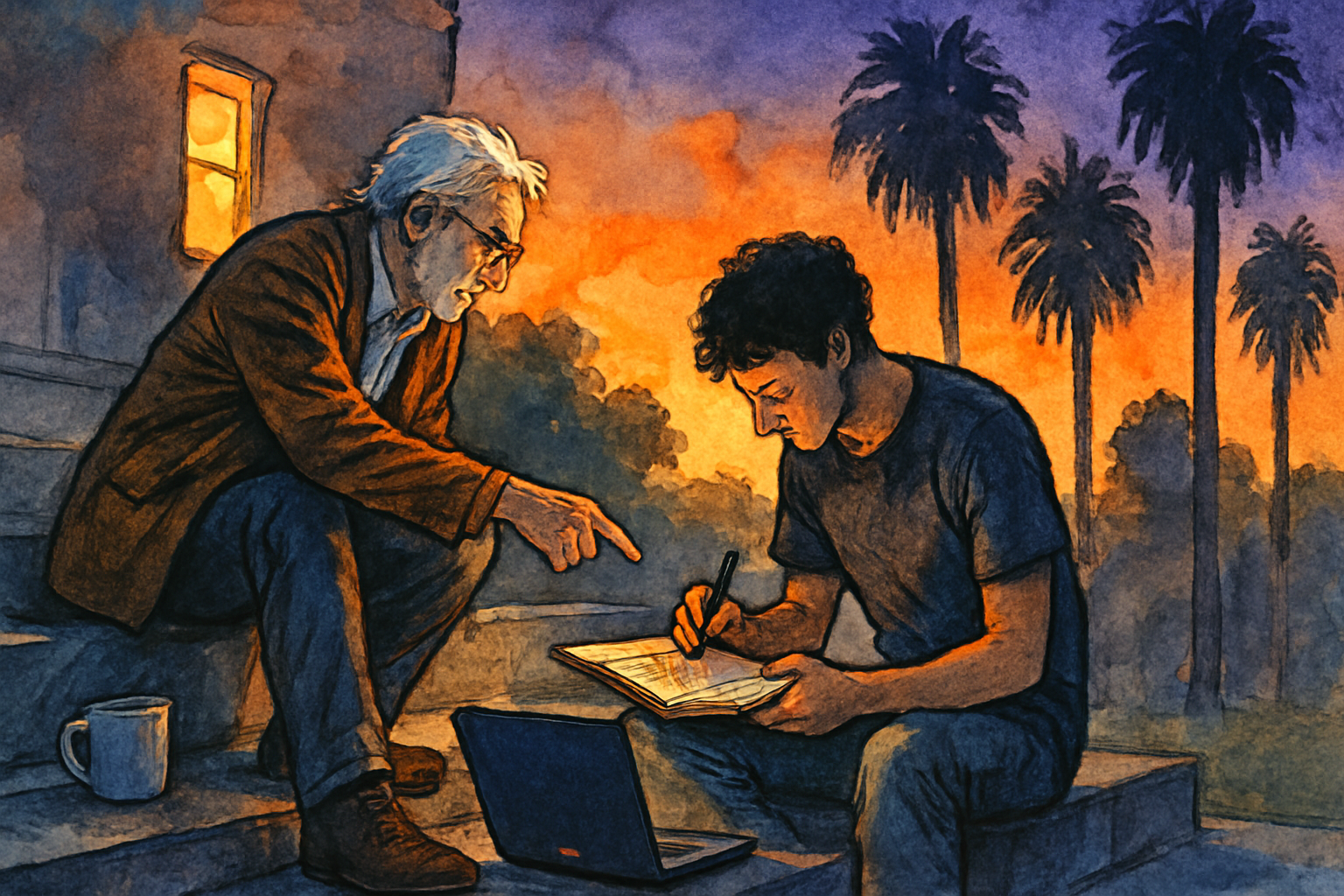
I tell the mierda story to my students because the same principle lives in my classroom, and it has for twenty-five years. I don’t walk in expecting students to speak my language, to arrive already knowing the vocabulary I know, to perform fluency in something they came here to learn. I look at them and I ask: where are you, and how do I lead you from there to where you need to be, by meeting you where you actually are and building on that? If you showed up with zero background and fought your way to a C, that C means something different than a coasted A. It means the distance traveled. It means the effort to close the gap.
You don’t have to get it right. You have to mean it.
— Greg Williams
The Landmark Collection fax taught me that the effort to close the distance between yourself and another person, even when you fail at it, especially when you fail at it, is what makes you worth knowing. You don’t have to get it right. You have to mean it. And sometimes the most convincing proof that you mean it is the hemispheric pile of fax-machine responses you generate by getting it so thoroughly, magnificently wrong.
For Further Reading
The mierda story touches on trust, cross-cultural communication, and what it actually means to reach people. These pieces go deeper on each thread.
- The Year I Lost Everything (And the Parking Lot That Changed It) — The collapse at 38 and the long process of rebuilding from scratch; shares the same thread about what endures when everything else is stripped away.
- You Don’t Have to Choose One Life — On carrying multiple identities — teacher, photographer, preacher, international businessman — and why Greg was told to pick one and refused.
- The Difference Between Authority and Impact Is Whether You Listen — What it looks like to actually meet people where they are, in the classroom and out of it.
- Learning to See: The Skill Nobody Teaches You (That Changes Everything) — On cultivating genuine curiosity about how other people experience the world — the skill underneath the mierda lesson.
- If It Wasn’t an A, I Didn’t Turn It In (And What That Cost Me) — The education post that pairs directly with this one: on effort, growth, and what grades actually measure.
- Permission Marketing — Wikipedia — Seth Godin coined the term in 1999. Greg was doing it via trilingual fax blasts in 1991. The concept of consistent, valuable communication that builds relationship before it asks for business.
- Building Trust Through Vulnerability and Transparency — Fast Company — How authenticity and admitting mistakes build stronger business relationships — the mechanism behind what the mierda fax actually did.
- Why Speaking Your Customers’ Language Is Important — ChatLingual — The business case for communicating in your customer’s native language, which Greg understood decades before it became a best practice.