—
Let me tell you about the motion designer who went to the wrong interview.
He had an appointment at one company, walked into the wrong building, sat down in the wrong lobby, and when they called his name he figured, well, I’m already here. He took the meeting. You know what that wrong meeting turned into? Two Stanley Cup rings. Two. He ended up doing motion design for a professional hockey organization, and I don’t even think he was a hockey fan, and he has two championship rings sitting on a shelf somewhere because he misread an address. I have turned that story over in my mind probably a hundred times in the twenty-five years I’ve been teaching, and every time I do I arrive at the same uncomfortable place: if he had found the right building, none of it happens.
So let’s talk about what we tell students, because I think we get this badly wrong.
We hand students a portfolio review and a LinkedIn profile and the general cultural message that there is a path, and your job is to find it and get on it, and if you’re talented and disciplined and do everything right you’ll arrive somewhere good. And I understand why we do that, because it’s tidy and it gives students something to aim at, and aim is better than paralysis. But it is, if I’m being honest with you, largely a fiction. The most successful people I know in this field, the ones who are genuinely doing interesting work and living interesting lives, almost none of them are standing where they aimed. They are standing somewhere better, or somewhere stranger, or somewhere they couldn’t have imagined at twenty-two.
I had a work-study student years ago who was sharp, I mean genuinely sharp, and I pushed her toward a marketing assistant position that she thought was absolutely beneath her. She told me so. She thought it was a step down, thought the title wasn’t right, thought it wasn’t what she’d studied for, and I had to make the case that sometimes the door that opens is the one you walk through regardless of what the sign says. She took the job. She rose to VP of Marketing Communications at the United Way. And I think about that conversation in the parking lot, that resistance she had to something that turned out to be the beginning of her actual career, and I wonder how many students walk away from their version of that moment because the packaging was wrong.
There was a guy who worked Publix pre-press, and he was extremely critical of the graphic design work coming through, not always charitably, but if you listened carefully he wasn’t wrong about production, he understood production in a way that was actually rare, and that turned out to be the thing. He moved through pre-press to large format to management, and at thirty-eight years old he became the managing director of Publix’s sustainability division. You know what his degree said? Graphic design. You know what his job description involves? Almost none of what that degree prepared him for in any direct sense. But all of it, somehow, led there.
I had a quiet student, and I mean that in the best possible way, the kind of quiet that’s actually just deep, who started a small religious magazine. Ran it for seven years, sold it, then built a production company out of what he’d learned. I had another student who became an Army intelligence officer, and I had closed-door meetings about security clearances that I had never had in my life before and have not had since. And then there’s the student whose path shifted after a family tragedy, and he and his wife bought a travel trailer and have spent fifteen years moving around this country, designing t-shirts and websites and bumper stickers out of whatever town they happen to be parked in. He makes a living. He has a life. It looks nothing like the graphic design career the curriculum was preparing him for, and it is completely, legitimately, beautifully his.
Every graphic design journey has its own course. I believe that the way I believe anything I’ve actually watched happen repeatedly, not as a philosophy but as a documented pattern of real human lives.
And here’s where I have to tell you about myself, because I don’t think I get to make this argument without it.
When I was young I wanted to be three things: a teacher, a photographer, and a preacher. I was told, with various degrees of kindness and various degrees of confidence, that all three were impractical. Not one of them, all three. And so I spent decades believing I had to pick one, or pick none, or figure out how to fold myself into something else entirely that looked more like a career and less like a wish list. I became a teacher at thirty-nine and a half, and I want you to hear the specificity of that number, because it wasn’t a plan, it was a sequence of accidents. I ran into a woman named Jennifer Baron in a parking lot. She connected me to a cleaning guy at the college, I mean he was literally in charge of building maintenance, and somehow that led to a conversation with a department head named AJ Chase who asked, would you do us a favor and teach a class? That was it. That was the whole origin story. A parking lot, a janitor, a favor.
I got serious about photography through a camera club called the Lakeland Shooters, which I didn’t join until a decade into teaching. And I was ordained as a minister online at sixty years old. Sixty. All three things I was told were impractical in my twenties manifested before I was done, and none of them arrived on anyone else’s timeline, and none of them arrived through any door I could see from where I was standing when I wanted them.
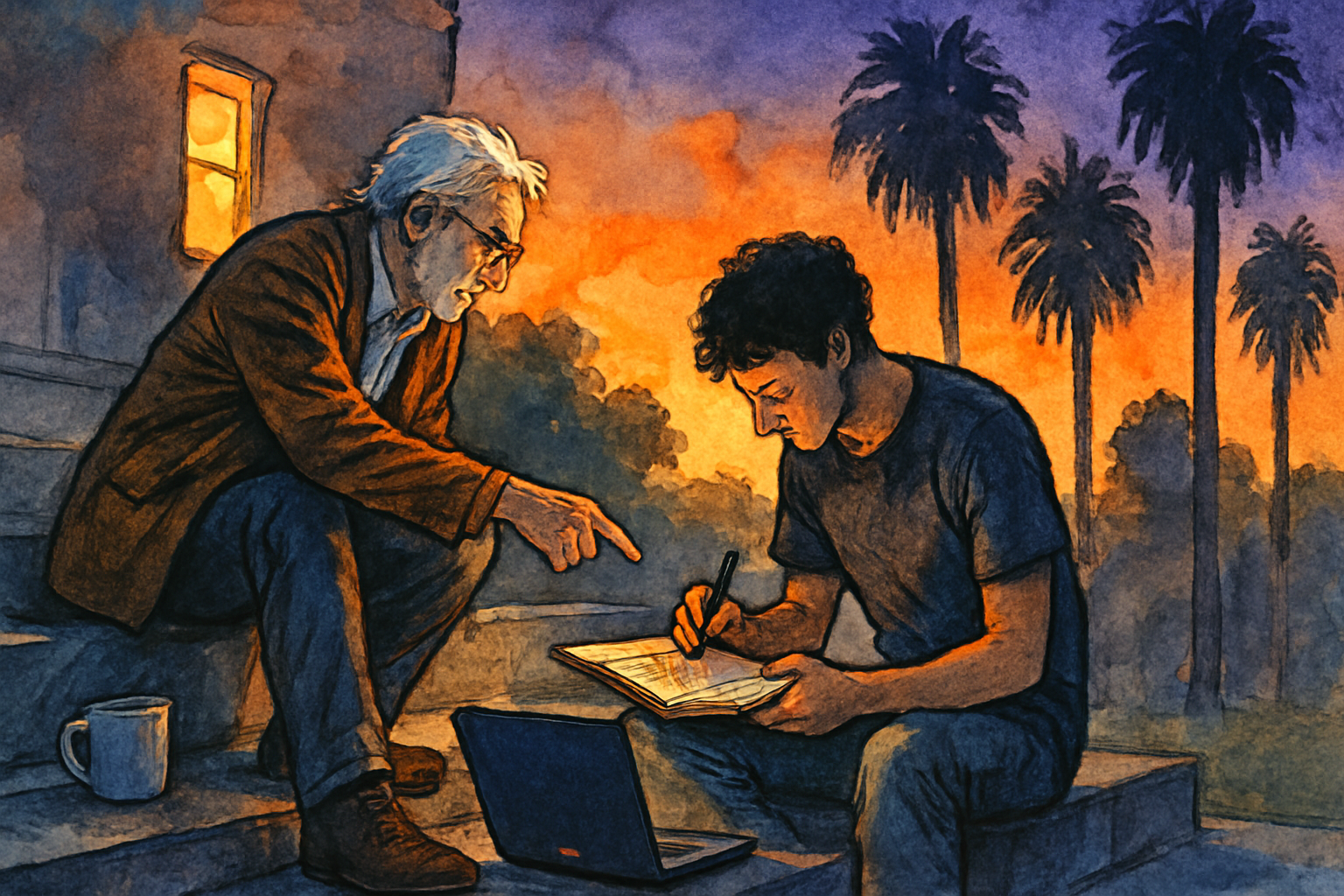
So when a student sits across from me and they’re anxious, and they’re always anxious, about whether they’re on the right track, whether their portfolio is pointed in the right direction, whether they’re going to be okay, I try to tell them the honest thing, which is that the track is not what they think it is. The anxiety makes sense, I’m not dismissing it, because the uncertainty is real, but the thing generating the anxiety, this idea that there is a correct trajectory and you might miss it, that part is not real. That part is a story we tell because it’s easier to aim at a target than to practice being ready for targets you don’t know are coming.
What the people I described have in common is not that they found the right path. It’s that they stayed open, they took the meeting in the wrong building, they took the job with the wrong title, they moved through pre-press when pre-press wasn’t glamorous, they parked the trailer and opened the laptop and did the work available to them. That’s the whole thing. That’s the career strategy that actually works, and it doesn’t fit on a career counseling handout, but it’s what I’ve watched for twenty-five years.
You don’t need to know where you’re going. You need to be the kind of person who shows up for the wrong interview and stays curious about what happens next.
—