—
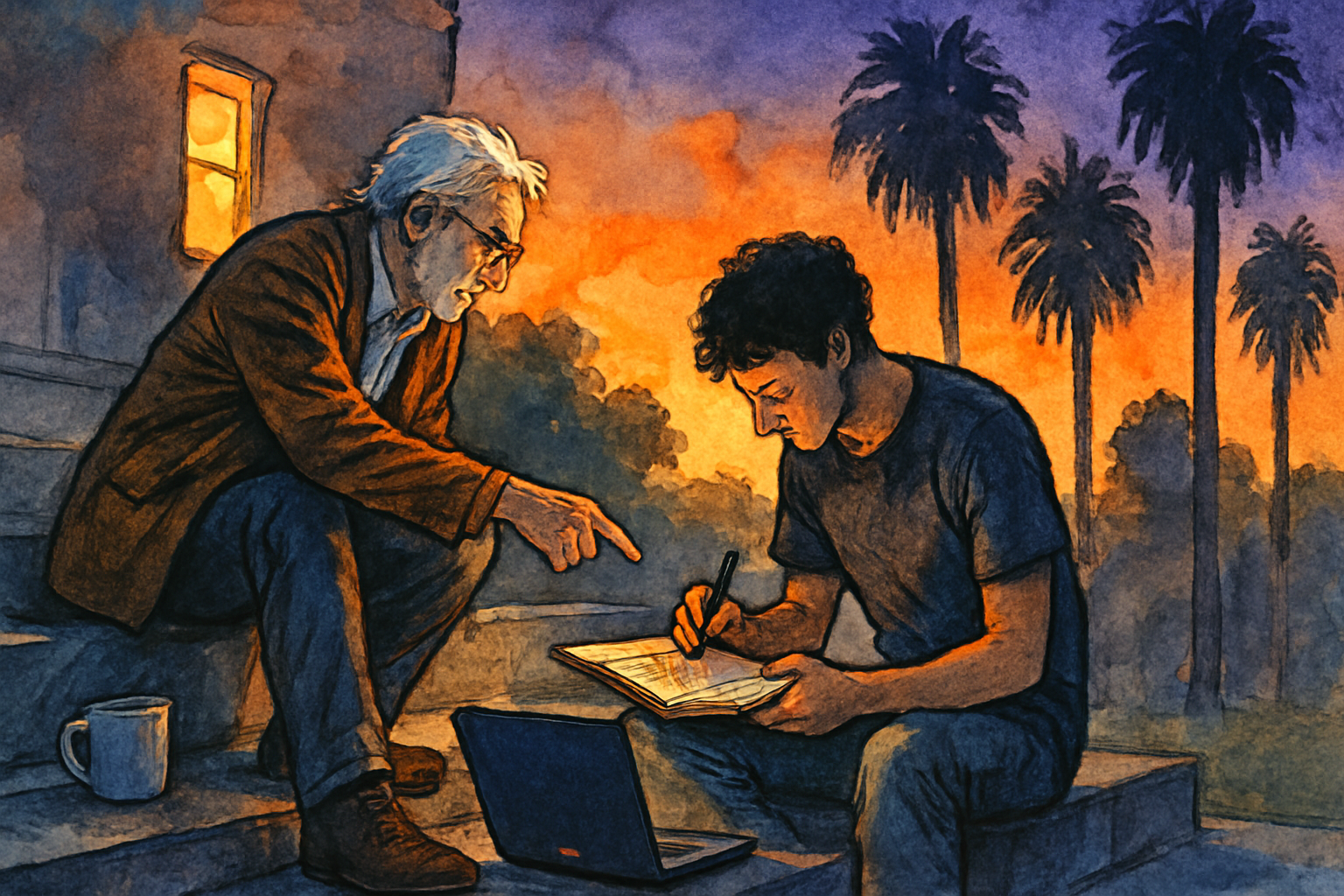
Let me tell you about a kid I’ll call Marcus, because that’s not his name but the story belongs to him and I want to protect that, and because the details of what happened to him are specific enough that you don’t need his name to feel the weight of it.
Marcus had been to two other colleges before he landed in my program, and neither of those experiences had gone particularly well for him, and you know, that’s not an unusual story. A lot of the students I’ve worked with over the years came to me by a roundabout road, not because they were the obvious candidates for a design education but because something hadn’t clicked yet, or the environment wasn’t right, or honestly sometimes the program wasn’t right, and they needed to find the place where the work actually made sense to them. Marcus’s mom had pushed him toward my program, and I’m grateful she did, because once he got there he was one of those students you remember. Dedicated. Hard-working in the way that shows up not just when things are interesting but when things are hard. Real leadership instincts. He graduated with his associate’s degree in graphic design and he had done the work to earn it.
And then he did what every graduate does, which is go home, open the job boards, start sending resumes, optimize the portfolio for every listing that comes up, and basically join the hundred thousand other graduates all running the same race with the same playbook at the same time. You know how that goes. It’s not a bad strategy, it’s just not a differentiating one, and the people who succeed at it are often the ones who catch a lucky break or know somebody or land in the right city at the right moment. Marcus kept at it, kept applying, and eventually he got an interview with the Tampa Bay Lightning.
He thought it was for a graphic design position. It was not. It was a motion design position, and there’s a meaningful gap between those two things, and anyone who has been on either side of a hiring conversation in this field knows that gap can feel enormous when you’re sitting across a desk from someone who is trying to figure out if you can actually do the job. Marcus had done some Flash animations back in school, a little video editing in high school, enough to know the general territory but not enough to call himself a motion designer with a straight face. And here’s where the story turns, and where I want you to pay attention, because this is the part that matters.
He didn’t apologize and he didn’t oversell and he didn’t pretend. He said: I have learned to work in twelve programs in twelve months at school. Give me two weeks, and if you aren’t satisfied, go ahead and let me go. That’s it. That’s the whole pitch. The confidence in it isn’t bravado, you know, it’s not a bluff. It’s a guy who has actually experienced his own capacity for learning, who has the evidence of his own adaptability in his hands, and who is offering that evidence as collateral. They gave him the shot.
He asked around for the best After Effects tutorials. Everyone he talked to named the same one. So he went there and he studied all night every night and he worked every day, and he kept his position. He rose to motion designer, and then he hit a plateau at some point the way people do, and he left for about a year, and then he came back and they gave him his former boss’s position. And eventually he became director of production for the Lightning, which means he was leading the team responsible for everything visual that happened during a hockey game that wasn’t the game itself: the scoreboards, the graphics around the arena, the images projected onto the ice, the advertisements, all of it, the entire sensory environment that ten or fifteen thousand people were sitting inside for three hours. Somebody called it the greatest show on ice, and that wasn’t a casual compliment from a casual source. He has two Stanley Cup rings from his time with that organization. He now oversees all audiovisual production for one of the busiest auditoriums in the world. And it started because he showed up for the wrong interview with the wrong portfolio and said give me two weeks.
Here’s the thing I keep coming back to, though, and it’s the thing I try to get students to understand when I tell this story, which I have told probably a hundred times because it deserves to be told that many times: the two weeks only worked because of the twelve months. The confidence in that room didn’t come from nowhere. It came from a year of building learning habits, of picking up software after software after software and discovering that the process is transferable even when the tools are different, of finding out through actual experience that you can do this, that the gap between not knowing something and knowing it is crossable, that it costs effort and time but it doesn’t cost anything you don’t have. Marcus had already paid that cost once, in school, in the studio, on the nights when the work was hard and he stayed anyway. So when the moment arrived in that interview room, he wasn’t making a gamble. He was making a statement about something he already knew to be true about himself.
And I think a lot of what we tell students about preparation gets this wrong, or at least incomplete. We tell them to prepare their portfolio, to prepare their skills, to prepare for the specific job they are applying for, and all of that is real and valid and worth doing. But we don’t always say loudly enough that the deepest preparation isn’t for a specific outcome, it’s for an unexpected one. Because the unexpected one is, very often, the actual one. Marcus’s resume had graphic design on it. The Lightning had motion design in mind. Those two things didn’t match. And yet every real skill he had, every real capacity he had developed, every real habit of mind he had built, those were completely transferable. The wrong interview was the right interview, and he could only know that because he’d already done the work to make himself capable of recognizing it.
I’ve been doing this for twenty-five years, and I have watched students take paths I never anticipated, into industries and roles that didn’t exist when they were in my classroom, and the ones who navigate those paths well are rarely the ones who planned for them. They’re the ones who built something in themselves that travels. You can’t put that in a portfolio, exactly, but you carry it into every room you walk into, and sometimes it’s the only thing that matters, and on the best days it’s enough to earn two weeks and change your whole life.
If you’re a student reading this, I want to leave you with one thing. Stop trying to be perfectly prepared for the position in the job listing. Start trying to be genuinely prepared for the position you can’t see yet. Those are different projects, and the second one is the one worth spending your nights on.
—
This post is part of the “What I Tell Students” series.
Keep Reading
- Nobody Gets There the Way They Planned
- Okay, So I Have Some Explaining to Do
- What Was Driving You Before
- Meet Me Where You Are
Go deeper: What Creativity Actually Is · All Primers