—
I bought this domain years ago and I honestly could not tell you with any certainty what I planned to do with it, because the truth is I probably didn’t have a plan so much as I had a habit, and the habit is buying domains. You know how some people collect sneakers or vintage cameras or whatever, and the collection makes sense to them even if it doesn’t make sense to anyone else? I collect domains. I get an idea, I buy a domain, and most of them just sit there and expire and I pay the renewal fee once or twice before I admit to myself that the idea isn’t happening. I have a graveyard’s worth of those. But kugraphics.org was different, because I actually used it, or at least I used it the way I use a lot of things, which is to say I used it for my students before I used it for myself.
The original purpose was practical and unglamorous. I needed a practice server. I teach social media, web development, branding, and when you’re teaching students how those things work, you need a place where they can actually try things without breaking anything that matters, and so this domain became that place, a sandbox, a scratchpad, something to point at and say “go build something here.” And it served that purpose well enough, and years passed, and the domain kept renewing, and somewhere in there I started writing on it, and then I kept writing, and somewhere in the middle of that I had this realization that was both obvious and a little bit embarrassing, which is that this could be exactly the thing I had been telling my students to build for twenty-five years.
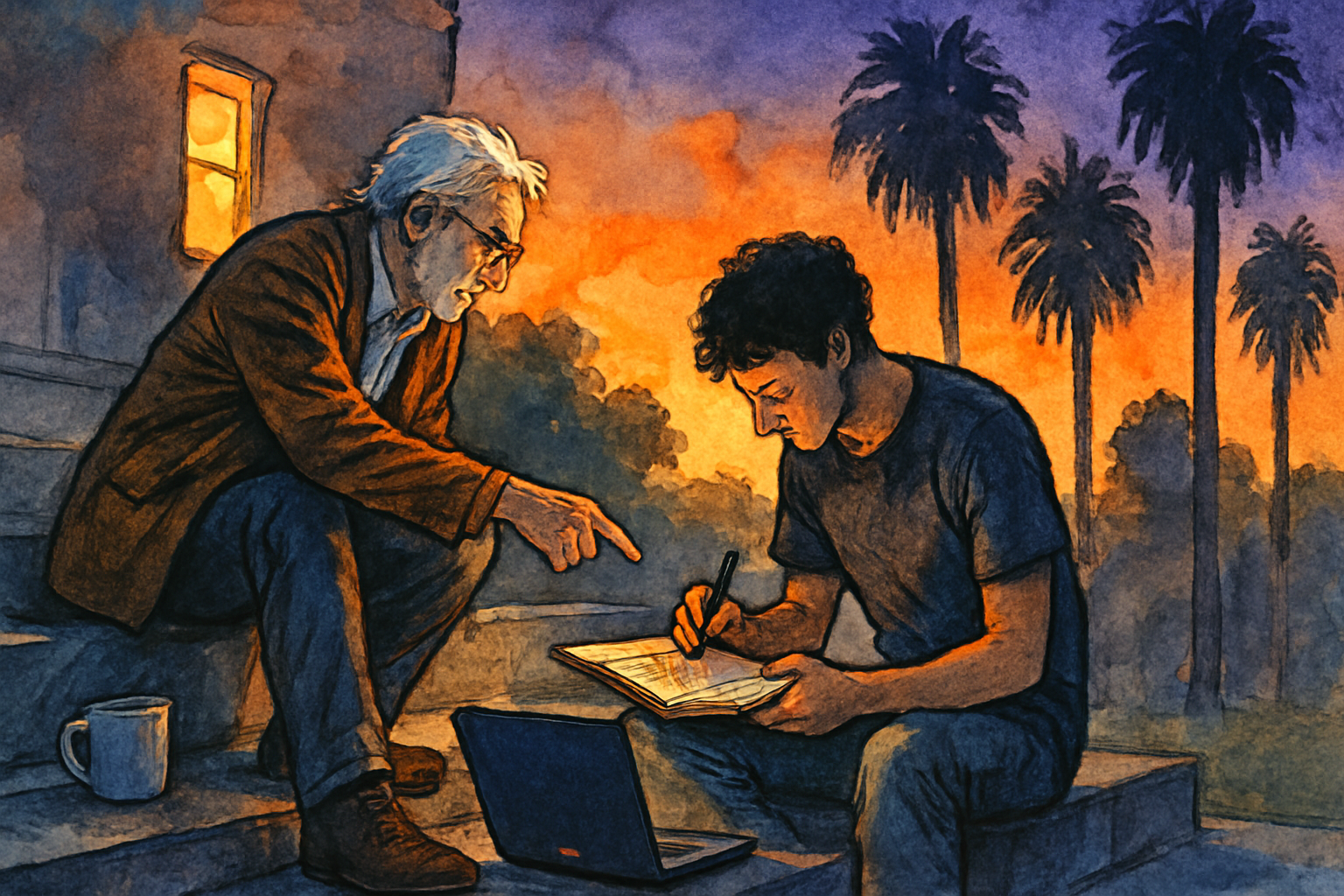
Let me tell you about my daughter Ashley, because this story doesn’t make complete sense without her. Ashley is the founder of A-Cross Careers and she specializes in career development for neurodivergent populations, and before that she worked in job placement at Carnegie Mellon on the graduate student side, and she knows what she’s doing, and I don’t mean she knows what she’s doing the way a proud father says that about his kid. I mean I watched her walk into my Portfolio Development course and deliver a two-hour session on LinkedIn strategy and I sat in the back of that room with my mouth open, because I didn’t recognize the person at the front of it. She looked like my daughter, you know, but the person talking was someone I had apparently not met yet, and what she said was sharp and specific and grounded in actual research about how hiring works and how recruiters move through a profile and what the algorithm does and doesn’t reward, and my students were leaning forward the whole time, which is a thing you notice when you’ve been teaching long enough to know that leaning forward is not a given.
And then class ended, and I walked out thinking about my own LinkedIn profile, and here is what my LinkedIn profile looked like at that moment: 234 connections, zero post impressions, a Santa Claus photo (and I mean an actual Santa Claus photo, which is a whole separate story), and an About section that was one sentence long. One sentence. I have been in design education for twenty-five years and I had written one sentence about myself on the professional platform that my daughter had just spent two hours explaining to my students was the single most important tool they had going into the job market. You know, there is a specific kind of humbling that only your kids can deliver, and I am here to tell you it lands differently than any other kind.
But here is what I want to be honest about, because I think it matters: it wasn’t laziness, exactly. It was avoidance, which is a different thing and in some ways a worse thing, because laziness you can fix with effort and avoidance requires you to understand what you’re actually afraid of before you can move past it. And I think what I was afraid of, if I’m being straightforward about it, is the same thing I’ve watched students be afraid of for decades, which is that the work won’t be good enough, or the voice won’t be right, or the whole thing will just sit there and nobody will engage and you’ll feel like you shouted into an empty room. That fear doesn’t go away when you get a master’s degree or when you’ve been teaching for a generation. It just gets quieter, or you get better at talking yourself out of acting on it, which is its own problem because you stop feeling the fear and start just… not doing the thing.
My students graduate and then something happens, and I have watched it happen enough times to recognize the pattern. The portfolio goes stale. The vocabulary fades. The confidence that they built in the program starts to compress under the weight of jobs and life and the general busyness of being an adult in the world, and the professional presence they worked so hard to build stops reflecting who they actually are, or what they’ve learned since, or where they’re trying to go. And they reach out, five years later, ten years later, sometimes fifteen, and I hear it in how they write, this uncertainty about whether the thing they built still means anything. Half of my closest friends are former students at this point, and I say that not to sound sentimental but because it’s just true, and because it means I have a pretty clear view of what the gap between graduation and now actually looks like from the inside.
The blog exists partly for them. Not for them in a patronizing way, not “here is advice from your old professor,” but for them in the sense that the teaching doesn’t have to stop when the semester ends, and the conversation that started in a classroom can continue somewhere, and the vocabulary doesn’t have to fade if there’s a place where it stays alive. And I think a living example of what a professional presence can look like over time, built in public, with all the awkwardness of starting late and figuring it out as you go, is more useful than anything I could put on a syllabus.
So that’s what this is. It’s a place where I write about design education and teaching and creative work and the things I have learned by doing this for a long time, and it’s also, honestly, me finally doing the thing I have been telling other people to do. The domain survived. I kept renewing it without quite knowing why, and now I think I know why, and so here we are, and if you want to come back and read more, I’ll be here, still figuring it out, same as everyone else.
Keep Reading
- Nobody Gets There the Way They Planned
- The Resume Problem: Why My Students Can’t See Their Own Skills
- He Showed Up for the Wrong Job and Got Two Stanley Cup Rings
- The MySpace Classroom
Go deeper: What Creativity Actually Is · All Primers